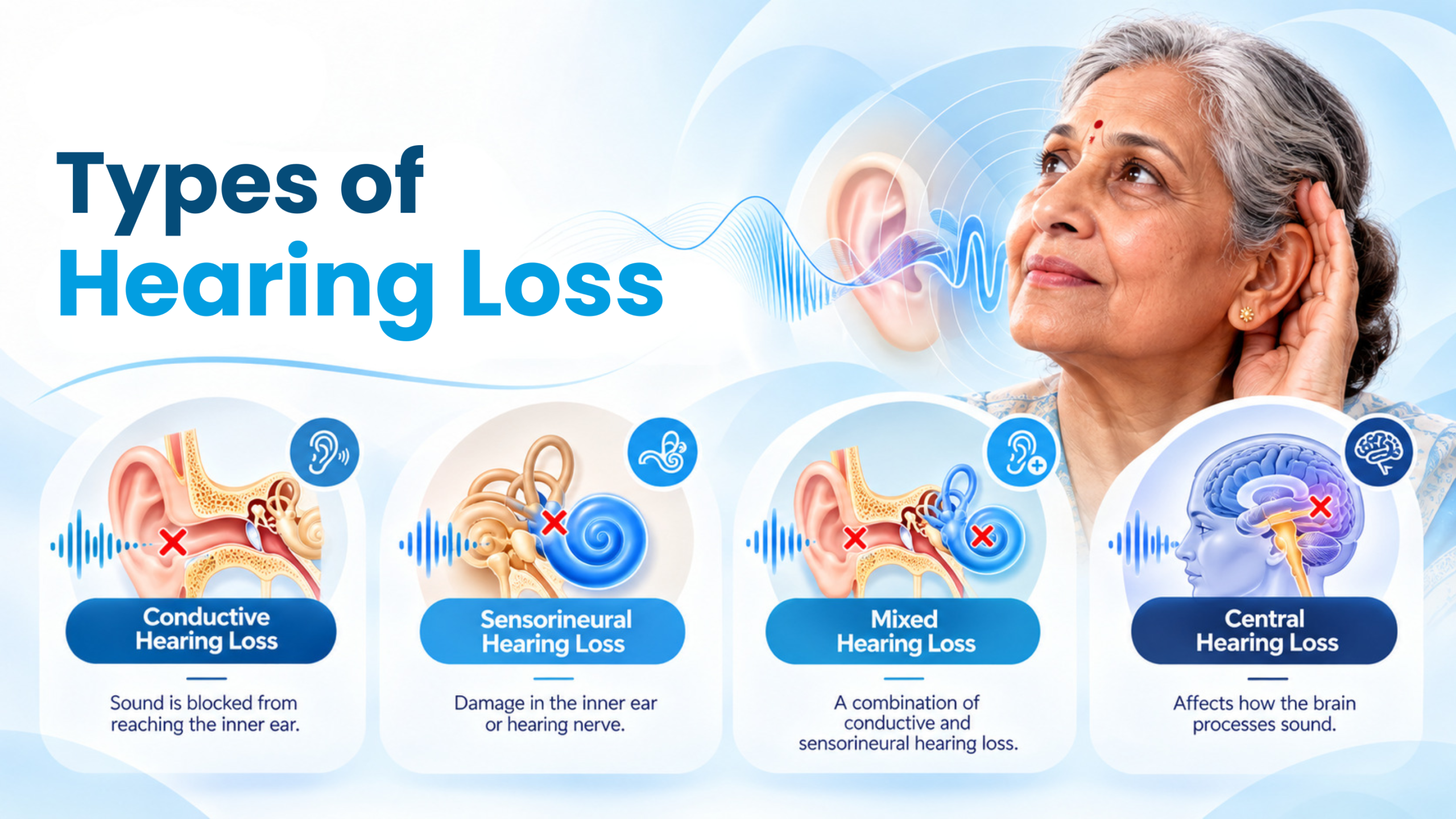
Hearing loss affects roughly 1.5 billion people worldwide in some form, according to global health estimates, and the number continues to climb as populations age and noise exposure increases. Yet most people only learn the specifics—what kind of hearing loss they have, why it happens, and what can actually be done about it—after a diagnosis. Understanding the different types of hearing loss beforehand makes it far easier to catch warning signs early and pursue the right treatment quickly.
This guide breaks down the three main categories of hearing loss, their causes, the symptoms that distinguish them, and the treatment paths available today.
What Is Hearing Loss?
Hearing loss is a partial or total inability to detect sound in one or both ears. It can appear suddenly or develop gradually over years, and it can range from a mild difficulty catching soft sounds to complete deafness. Doctors classify hearing loss based on where in the ear or auditory system the problem originates, which is what determines both the symptoms a person experiences and the treatments likely to help.
The Three Main Types of Hearing Loss
Hearing loss is generally grouped into three categories, based on which part of the hearing pathway is affected.
| Type | Where It Occurs | Typical Onset | Reversible? |
|---|---|---|---|
| Conductive Hearing Loss | Outer or middle ear | Often sudden | Frequently yes |
| Sensorineural Hearing Loss | Inner ear (cochlea) or auditory nerve | Usually gradual | Usually permanent |
| Mixed Hearing Loss | Combination of outer/middle and inner ear | Variable | Partially |
A fourth, less common category — central auditory processing disorder — involves the brain’s ability to interpret sound rather than a physical problem with the ear itself. While not always listed alongside the three primary types, it’s increasingly recognized in both pediatric and adult audiology.
1. Conductive Hearing Loss
Conductive hearing loss happens when sound waves can’t efficiently travel through the outer ear canal to the eardrum and the tiny bones (ossicles) of the middle ear. It’s essentially a mechanical blockage or structural problem, which is why it’s often the most treatable type.
Common causes:
- Earwax (cerumen) buildup or blockage
- Fluid in the middle ear from colds or allergies
- Ear infections (otitis media)
- A perforated or ruptured eardrum
- Otosclerosis (abnormal bone growth in the middle ear)
- Foreign objects lodged in the ear canal
- Malformed outer or middle ear structures (present at birth)
- Benign tumors
Typical symptoms:
- Sounds seem muffled or quieter than usual
- Certain frequencies are easier to hear than others
- A feeling of fullness or pressure in the ear
- Pain or drainage from the ear (if infection-related)
2. Sensorineural Hearing Loss (SNHL)
Sensorineural hearing loss is the most common form overall and involves damage to the hair cells inside the cochlea or to the auditory nerve that carries sound signals to the brain. Because these structures don’t regenerate on their own, this type of hearing loss is usually permanent.
Common causes:
- Natural aging (presbycusis)
- Prolonged exposure to loud noise
- Genetic or hereditary factors
- Viral infections (such as measles, mumps, or meningitis)
- Ménière’s disease
- Ototoxic medications (certain antibiotics, chemotherapy drugs)
- Head trauma
- Acoustic neuroma (a noncancerous tumor on the auditory nerve)
- Complications during birth, including low birth weight or oxygen deprivation
Typical symptoms:
- Gradual difficulty understanding speech, especially in noisy settings
- Trouble hearing high-pitched sounds (birds, alarms, phone rings)
- Tinnitus (ringing, buzzing, or hissing in the ears)
- Dizziness or balance problems, particularly with Ménière’s disease
- Speech from others may sound slurred or mumbled even when volume is adequate
3. Mixed Hearing Loss
Mixed hearing loss is exactly what it sounds like — a combination of conductive and sensorineural hearing loss occurring at the same time, often in the same ear. Someone might, for example, have age-related nerve damage along with a current ear infection layering additional loss on top.
Common causes: Any combination of the causes listed above — for instance, chronic ear infections in someone who also has noise-induced inner ear damage.
Typical symptoms: A blend of both categories — muffled hearing plus difficulty with speech clarity, sometimes accompanied by tinnitus.
Degrees of Hearing Loss
Beyond type, hearing loss is also measured by severity, expressed in decibels (dB) — the softest sound a person can detect.
| Degree | Hearing Threshold (dB) | What It Sounds Like |
|---|---|---|
| Normal | −10 to 15 dB | No difficulty hearing |
| Slight | 16 to 25 dB | Difficulty with faint or distant speech |
| Mild | 26 to 40 dB | Trouble following conversation in noise |
| Moderate | 41 to 55 dB | Difficulty with normal conversation |
| Moderately Severe | 56 to 70 dB | Conversation must be loud to be understood |
| Severe | 71 to 90 dB | Loud speech understood only up close; some shouting needed |
| Profound | 91+ dB | Little to no hearing; may rely on vibration or visual cues |
Symptoms That Warrant a Doctor’s Visit
Most hearing loss develops slowly, but certain symptoms should prompt urgent evaluation rather than a “wait and see” approach:
| Symptom | Why It Matters |
|---|---|
| Sudden hearing loss (over hours or days) | Considered a medical emergency; early steroid treatment improves outcomes |
| Hearing loss with facial drooping or slurred speech | Could indicate stroke |
| Hearing loss with fever or ear pain | May signal infection requiring prompt treatment |
| Hearing loss after a head injury | Needs imaging to rule out structural damage |
| One-sided hearing loss with dizziness or tinnitus | May indicate acoustic neuroma or Ménière’s disease |
If any of these apply, seeing a physician — ideally an otolaryngologist (ENT) — within days, not weeks, meaningfully improves the odds of recovering some or all hearing.
Causes at a Glance
| Cause Category | Examples | Associated Hearing Loss Type |
|---|---|---|
| Aging | Presbycusis | Sensorineural |
| Noise exposure | Concerts, machinery, firearms, headphones | Sensorineural |
| Infections | Ear infections, meningitis, measles, mumps | Conductive or Sensorineural |
| Genetics | Inherited syndromes, congenital malformations | Any type |
| Trauma | Head injury, eardrum perforation, pressure changes | Conductive or Sensorineural |
| Medications | Certain antibiotics, chemotherapy, high-dose aspirin | Sensorineural |
| Tumors | Acoustic neuroma, other growths | Sensorineural or Conductive |
| Obstruction | Earwax, foreign objects, fluid | Conductive |
| Disease | Otosclerosis, Ménière’s disease, autoimmune conditions | Conductive or Sensorineural |
Treatment Options
Treatment depends heavily on which type of hearing loss is diagnosed and how severe it is.
| Treatment | Best Suited For | What It Does |
|---|---|---|
| Earwax removal | Conductive (blockage) | Clears the ear canal |
| Antibiotics | Conductive (infection) | Treats underlying infection |
| Surgery (tympanoplasty, ossicular reconstruction) | Conductive (structural damage) | Repairs eardrum or middle ear bones |
| Steroids (oral or injected) | Sudden sensorineural loss | Reduces inflammation, may restore hearing if started early |
| Hearing aids | Mild to severe (conductive or sensorineural) | Amplifies sound |
| Cochlear implants | Severe to profound sensorineural | Bypasses damaged hair cells, stimulates auditory nerve directly |
| Bone-anchored hearing systems | Conductive or mixed, especially single-sided deafness | Transmits sound via bone conduction |
| Assistive listening devices | Any type, as a supplement | Amplifies specific sound sources (TV, phone, meetings) |
| Auditory-verbal therapy / speech therapy | Especially in children | Supports language development alongside hearing devices |
Most conductive hearing loss is amenable to medical or surgical treatment. Sensorineural hearing loss is usually incurable ; hearing aids and cochlear implants restore functional hearing without reversing the underlying nerve or hair-cell damage. This is one of the most important things a newly diagnosed patient can understand, as it sets realistic expectations for recovery.
How Hearing Loss Is Diagnosed
A hearing loss diagnosis typically involves:
- Physical examination — checking the ear canal and eardrum for wax, infection, or structural issues
- Pure-tone audiometry — the standard hearing test using a booth and headphones to map hearing thresholds across frequencies
- Tympanometry — measures how well the eardrum moves, useful for detecting fluid or perforation
- Speech testing — evaluates how well someone understands spoken words at various volumes
- Imaging (MRI or CT) — used when a tumor, structural abnormality, or nerve issue is suspected
Can Hearing Loss Be Prevented?
Not all hearing loss is preventable — genetic and age-related causes can’t be avoided — but a significant portion, particularly noise-induced hearing loss, is. Practical prevention steps include:
- Wearing hearing protection around loud machinery, concerts, or firearms
- Keeping headphone volume below 60% of maximum
- Taking breaks from prolonged loud noise exposure
- Treating ear infections promptly rather than letting them linger
- Reviewing medications with a doctor for ototoxic side effects
- Getting regular hearing checks after age 50, or earlier with risk factors
Frequently Asked Questions
What’s the most common type of hearing loss?
Sensorineural hearing loss is the most common overall, largely due to aging and cumulative noise exposure over a lifetime.
Is hearing loss reversible?
It depends on the cause. Conductive hearing loss from earwax, infection, or fluid is often reversible with treatment. Sensorineural hearing loss is usually permanent, though hearing aids and cochlear implants can restore substantial function.
Can hearing loss lead to other health problems?
Untreated hearing loss has been associated with social isolation, increased fall risk and a greater likelihood of cognitive decline, so early intervention is important for more than just communication.
When should sudden hearing loss be treated as an emergency?
If hearing loss develops within 72 hours and persists, it should be evaluated immediately—outcomes are significantly better when steroid treatment starts within the first one to two weeks.
What’s the difference between hearing loss and deafness?
Hearing loss is a spectrum—it can range from mild difficulty hearing soft sounds to a total inability to hear. “Deafness” typically refers to the profound end of that spectrum, where little to no functional hearing remains, with or without assistive devices.
Can children be born with hearing loss?
Yes. Congenital hearing loss can result from genetic factors, infections during pregnancy (such as rubella or cytomegalovirus), premature birth, low birth weight, or complications during delivery. Most hospitals perform a newborn hearing screening before discharge specifically to catch this early, since early intervention significantly improves speech and language outcomes.
Does tinnitus always mean hearing loss?
Not always, but the two is closely link. Tinnitus (ringing, buzzing, or hissing in the ears) frequently accompanies sensorineural hearing loss, but it can also occur on its own due to stress, certain medications, earwax buildup, or blood vessel issues near the ear.
Can one ear have hearing loss while the other is normal?
Yes, this is called one-sided or unilateral hearing loss. It’s usually caused by an ear infection, acoustic neuroma, sudden sensorineural hearing loss, or injury to just one ear. It still needs to be assessed because one-sided loss can sometimes be a tumor or other localized problem.
Are hearing aids the same as cochlear implants?
Nope. Hearing aids are devices worn in or behind the ears that make sounds louder. Hearing aids simply make existing sounds louder for the ear to process. Cochlear implants are devices that surgically implanted to bypass damaged parts of the inner ear and directly stimulate the auditory nerve Cochlear implants are usually recommended for people with severe to profound sensorineural hearing loss who get limited benefit from hearing aids
How much do hearing aids typically cost, and does insurance cover them?
Hearing aids generally range from a few hundred to several thousand dollars per ear depending on technology level, and coverage varies widely—traditional Medicare doesn’t cover hearing aids, though some Medicare Advantage plans, Medicaid programs, and private insurers do offer partial coverage. It’s worth checking with both a provider and insurer directly, since policies change often.
Can loud headphone use really cause permanent hearing loss?
Yes. Regularly listening at high volumes—especially above 85 decibels for extended periods—can damage the tiny hair cells in the cochlea, and that damage is cumulative and permanent. This is a major driver of noise-induced hearing loss in younger populations who previously wouldn’t have shown age-related decline.
Does hearing loss get worse over time if untreated?
It depends on the cause. Age-related and noise-induced sensorineural hearing loss typically progresses gradually if the underlying exposure or aging process continues unaddressed. Conductive hearing loss from something like an untreated infection can also worsen or become chronic. Early treatment—even just fitting hearing aids—doesn’t reverse nerve damage, but it does prevent the auditory processing decline associated with prolonged unaided hearing loss.
Can stress or anxiety cause hearing loss?
Stress does not directly damage the ear’s physical structures, but it link to conditions such as sudden sensorineural hearing loss and can exacerbate the perceived severity of tinnitus. Some studies have also linked chronic stress to Ménière’s disease flare-ups.
What is auditory processing disorder, and is it the same as hearing loss?
No—auditory processing disorder (APD) involves normal hearing sensitivity but difficulty with how the brain interprets and organizes sound, particularly speech in noisy environments. It is diagnosed differently from conductive or sensorineural hearing loss and is treated with auditory training and environmental accommodations rather than hearing aids.
Conclusion
Hearing loss is not one thing, but a spectrum of causes, severity and mechanism, ranging from a simple earwax blockage to permanent nerve damage. The first real step to effective treatment, which is either a quick procedure to clear an obstruction or a long-term plan based around hearing aids or cochlear implants, is to know what type and how serious it is. If you experience a slow change in hearing, or sudden hearing loss, consult an audiologist or ENT doctor promptly instead of delaying as early diagnosis always leads to the best outcomes.

One thought on “Types of Hearing Loss: Causes, Symptoms & Treatment Options”