Roughly 1.5 billion people worldwide live with some degree of hearing loss, yet most cases develop so gradually that they go unnoticed for years. Here’s what hearing loss actually is, the three main types, what causes it, and the early signs worth acting on.
Hearing loss rarely arrives all at once. It usually creeps in — a missed word here, the TV a little louder than it used to be, a conversation lost in a noisy restaurant. By the time most people schedule a hearing test, they’ve often lived with untreated hearing loss for several years. Understanding the types, causes, and early warning signs is the fastest way to catch it before it affects your relationships, work, and safety.

What Is Hearing Loss?
Hearing loss is a partial or total inability to hear sound in one or both ears. It’s measured in decibels (dB) — the quieter the sound a person can still detect, the better their hearing. Clinicians describe hearing loss along a spectrum, from mild difficulty picking up soft speech to profound loss where even loud sounds go undetected.
The World Health Organization classifies hearing loss of 20 dB or greater in the better-hearing ear as hearing loss of any kind, and 35 dB or greater as “disabling” hearing loss — the point where it meaningfully interferes with communication. Disabling hearing loss affects an estimated 430 million people globally today, a number the WHO expects to approach 700 million by 2050 as populations age.
| Degree of hearing loss | Hearing threshold | What it sounds like |
|---|---|---|
| Normal hearing | −10 to 15 dB | Soft sounds like a whisper are heard clearly |
| Slight | 16–25 dB | Faint or distant speech is hard to follow |
| Mild | 26–40 dB | Conversation in background noise is difficult |
| Moderate | 41–55 dB | Normal conversation is regularly missed |
| Moderately severe | 56–70 dB | Only loud, clear speech is understood |
| Severe | 71–90 dB | Even loud speech is hard to hear without aids |
| Profound | 91+ dB | Little to no sound is heard without a device |

The 3 Main Types of Hearing Loss
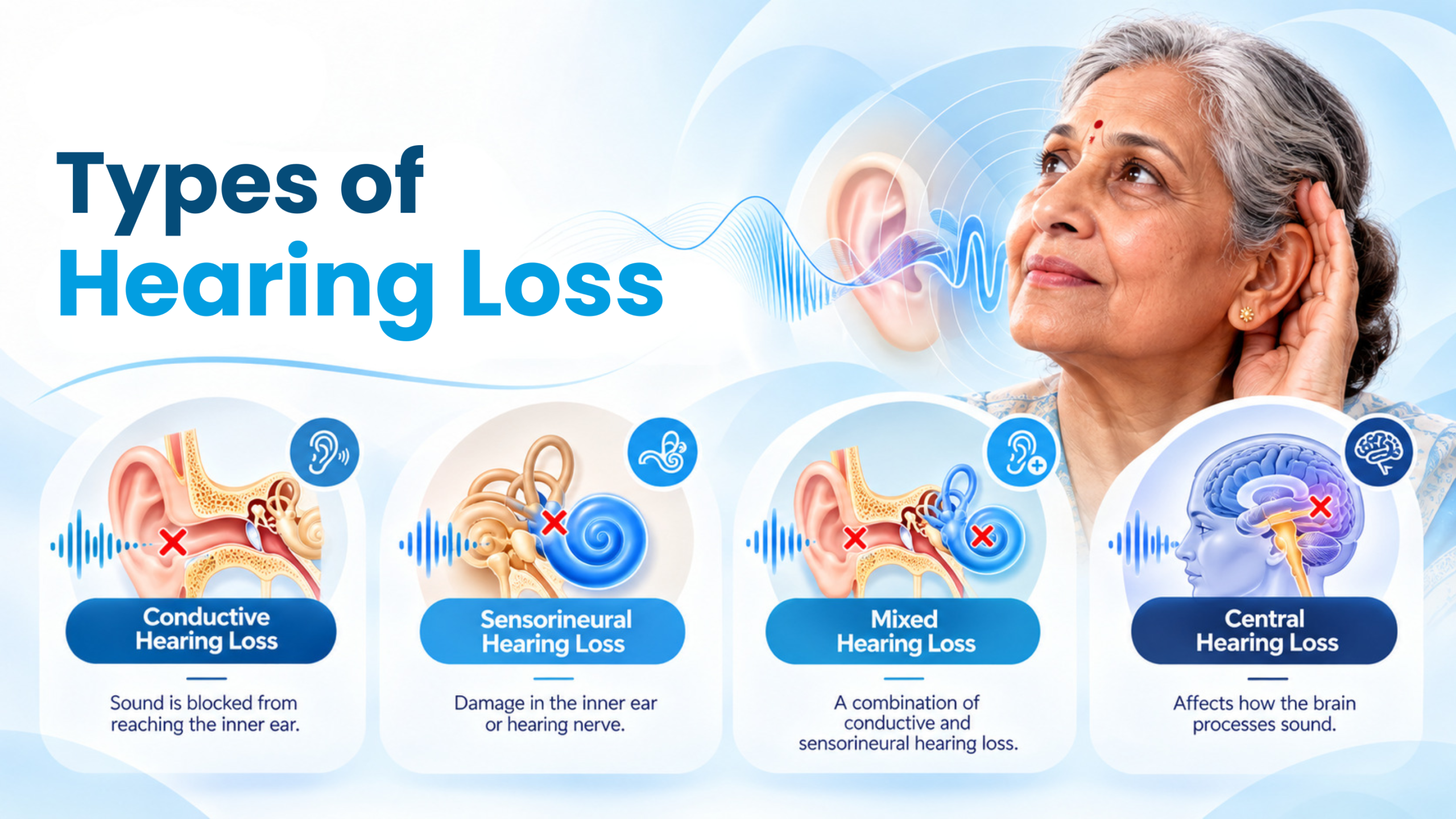
Nearly every case of hearing loss falls into one of three categories, defined by where in the ear the problem occurs.
1. Conductive hearing loss
This occurs when sound can’t efficiently travel through the outer or middle ear to reach the inner ear. Common causes include earwax buildup, fluid from an ear infection, a perforated eardrum, or abnormal bone growth. Conductive hearing loss is often temporary and treatable with medication or minor surgery.
2. Sensorineural hearing loss
The most common type, sensorineural hearing loss happens when the tiny hair cells in the inner ear (cochlea) or the auditory nerve are damaged. It’s usually permanent and is caused by aging, prolonged noise exposure, genetics, or certain illnesses. This type is managed with hearing aids or cochlear implants rather than cured.
3. Mixed hearing loss
A combination of conductive and sensorineural hearing loss occurring at the same time — for example, someone with age-related inner-ear damage who also has a middle-ear infection. Treatment addresses both components separately.
| Type | Where it happens | Typical causes | Usually reversible? |
|---|---|---|---|
| Conductive | Outer or middle ear | Earwax, fluid, infection, eardrum damage | Often, yes |
| Sensorineural | Inner ear / auditory nerve | Aging, noise exposure, genetics, illness | No — managed, not cured |
| Mixed | Both outer/middle and inner ear | Combination of the above | Partially |
Common Causes of Hearing Loss
- Aging (presbycusis) — gradual wear on the inner ear’s hair cells is the single biggest driver of hearing loss worldwide, affecting the majority of adults over 75.
- Noise exposure — repeated exposure to loud sound, from concerts and headphones to industrial equipment and firearms, is the leading preventable cause across all age groups.
- Genetics — more than half of childhood hearing loss has a genetic component, and family history also raises the risk of age-related loss.
- Ear infections and fluid buildup — chronic or repeated middle-ear infections, common in children, can cause lasting conductive damage.
- Ototoxic medications — certain chemotherapy drugs, high-dose aspirin, and some antibiotics can damage the inner ear.
- Illness and infection — measles, mumps, meningitis, and maternal infections during pregnancy are known causes, especially in children.
- Head or ear trauma — a skull fracture, sudden pressure change, or direct blow to the ear can damage the middle or inner ear.
- Earwax impaction — one of the most common and easily fixed causes of temporary hearing loss at any age.
Early Warning Signs of Hearing Loss
Because hearing loss is usually gradual, the people around you often notice it before you do. Watch for:
- Frequently asking others to repeat themselves
- Turning the TV or radio volume up higher than others prefer
- Struggling to follow conversations in restaurants or groups
- Thinking people are mumbling rather than speaking clearly
- Difficulty hearing on the phone
- Ringing, buzzing, or hissing in the ears (tinnitus)
- Trouble hearing children’s or women’s higher-pitched voices
- Withdrawing from social situations to avoid the strain of listening
- Feeling exhausted after conversations or meetings
- Missing doorbells, alarms, or other everyday sounds
When to get tested: if two or more of these signs sound familiar, or a family member has mentioned your hearing, it’s worth booking a hearing test. Most hearing loss is progressive — the earlier it’s identified, the more treatment options are available and the easier it is to adapt.
How Hearing Loss Is Diagnosed
An audiologist or ENT typically starts with a physical exam of the ear canal and eardrum, followed by pure-tone audiometry — a test using headphones that measures the quietest sound you can detect at different pitches. Speech testing checks how well you understand words at a comfortable volume, and tympanometry can assess middle-ear function if a conductive cause is suspected. The whole process usually takes under an hour and is painless.
Treatment Options
Treatment depends entirely on the type and severity of hearing loss:
- Earwax removal or medication resolves many conductive cases within days.
- Hearing aids are the standard treatment for mild to severe sensorineural hearing loss and now range from basic over-the-counter devices to advanced prescription models with noise cancellation and Bluetooth streaming.
- Cochlear implants are surgically placed devices for severe to profound hearing loss when hearing aids no longer provide enough benefit.
- Assistive listening devices, such as captioned phones and amplified alarms, support day-to-day communication alongside other treatment.
Despite how treatable most hearing loss is, adoption remains low: among U.S. adults who could benefit from a hearing aid, only around a quarter to a third currently use one — and for adults under 70, that figure drops closer to 1 in 6.
Not sure if it’s time for a hearing test?
A baseline hearing test takes less than an hour and gives you a clear picture of where you stand — whether that means reassurance, early monitoring, or a treatment plan. If any of the warning signs above sound familiar, booking a test is the single most useful next step.
Frequently Asked Questions
What are the 4 types of hearing loss?
The three core physiological types are conductive, sensorineural, and mixed hearing loss. Some clinicians add a fourth category, auditory neuropathy spectrum disorder, where sound reaches the inner ear normally but doesn’t transmit cleanly to the brain.
What is the most common cause of hearing loss?
Age-related hearing loss (presbycusis) and noise-induced hearing loss are the two leading causes worldwide. Age-related decline affects the majority of adults over 75, while noise exposure is the leading preventable cause across all ages.
Can hearing loss be reversed?
It depends on the type. Conductive hearing loss from earwax, fluid, or infection is often reversible with treatment. Sensorineural hearing loss, caused by inner-ear or nerve damage, is generally permanent and is managed with hearing aids or cochlear implants rather than reversed.
What are the first signs of hearing loss?
Early signs include asking people to repeat themselves, turning up the TV, struggling in noisy rooms, muffled speech, avoiding social situations, and tinnitus (ringing in the ears).
At what age does hearing loss usually start?
Age-related hearing loss typically becomes noticeable in a person’s 60s, though measurable decline in high-frequency hearing can begin as early as the 30s and 40s, especially with a history of noise exposure.
Is hearing loss a disability?
Hearing loss is generally classified as disabling once it reaches a threshold of 35 dB or greater in the better ear. Milder hearing loss isn’t classified as a disability but still benefits from treatment.
How is hearing loss diagnosed?
An audiologist uses pure-tone audiometry to measure the quietest sounds you can hear at different pitches, along with speech testing and, if needed, tympanometry to check middle-ear function.
Can hearing loss be prevented?
Noise-induced hearing loss — one of the largest preventable causes — can largely be avoided with hearing protection and by limiting exposure to loud sound. Age-related and genetic hearing loss can’t be fully prevented but can be caught early with regular hearing checks.

One thought on “What Is Hearing Loss? Types, Causes and Early Warning Signs”