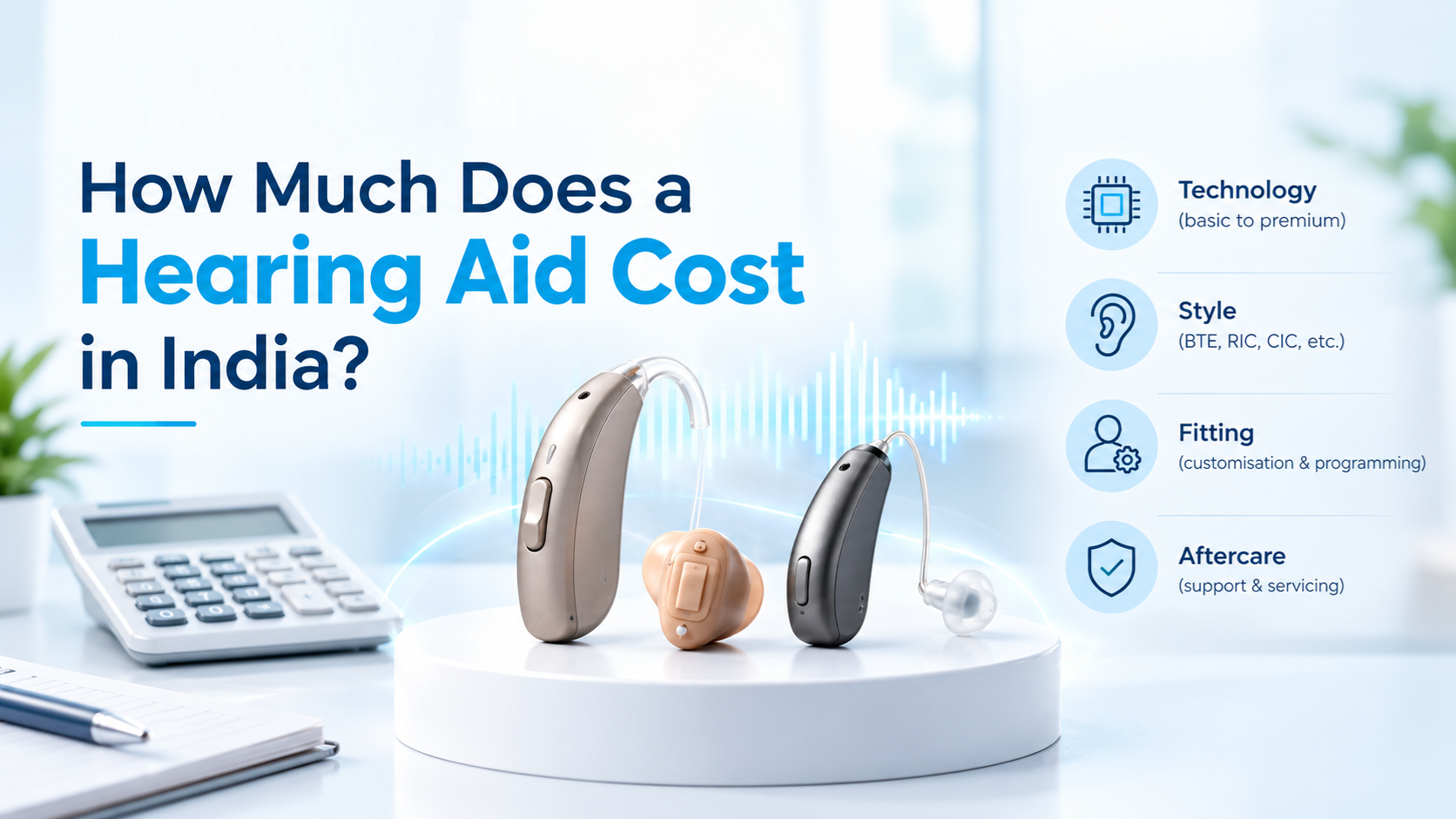
A hearing aid in India costs roughly ₹8,000 to ₹250,000 per ear in 2026, and for most adults a good, reliable pair lands between ₹40,000 and ₹150,000 in total. That is a wide range, and it is exactly why so many families feel lost when they first walk into a clinic.
If you or a parent have started saying “what?” more often, turning the TV volume up, or avoiding family gatherings because conversations feel like hard work, you are not alone. Hearing loss is one of the most common and most under-treated health conditions in India, and the average person waits several years before buying a first hearing aid. Price confusion is a big reason.
This guide is written from the buyer’s point of view. It explains what you will actually pay, why two devices that look identical can differ by ₹80,000, which costs nobody mentions up front, and how to avoid overpaying. You will also find the latest 2026 trends, from AI-powered sound processing to Bluetooth LE Audio, and what they mean for your wallet.
Quick answer: hearing aid price in India at a glance
Prices are per ear unless stated, because most people with hearing loss in both ears need two devices. Here is the approximate 2026 picture by technology level.
| Technology level | Approx. price per ear (₹) | Best suited for |
|---|---|---|
| Body-worn / basic analog (incl. government-supplied) | 3,000 – 8,000 | Tight budgets, simple use |
| Entry-level digital (2–4 channels) | 8,000 – 25,000 | Quiet homes, one-to-one talks |
| Standard digital (8–16 channels) | 25,000 – 50,000 | Working adults, occasional noise |
| Mid-premium (rechargeable, Bluetooth) | 50,000 – 90,000 | Active people, calls, streaming |
| Premium AI devices | 90,000 – 1,50,000 | Busy social life, restaurants, meetings |
| Flagship AI devices | 1,50,000 – 2,50,000 | Maximum clarity, latest chips |
In plain terms: a pair of basic digital aids can start near ₹20,000, a solid mid-range pair usually costs ₹80,000 to ₹1,20,000, and a flagship pair can cross ₹4 lakh. Most buyers who are happy two years later chose the middle of this table, not the top or the bottom. The right choice depends on your lifestyle and the type of hearing loss, not on the price tag.
The next sections explain where these numbers come from.
Hearing aid cost by style: BTE, RIC, ITE, CIC and more
Style affects price less than technology does, but it matters for comfort, visibility and repair costs. Smaller devices need more miniaturisation, so they often cost more for the same feature level.
| Style | Approx. price per ear (₹) | What to know |
|---|---|---|
| Body-worn | 3,000 – 8,000 | Box with wire; durable, easy to handle, very visible |
| BTE (behind-the-ear) | 10,000 – 80,000 | Powerful, good for severe loss, easy to repair |
| RIC / RITE (receiver-in-canal) | 25,000 – 1,80,000 | India’s most popular modern style: discreet, natural sound |
| ITE / ITC (in-the-ear) | 20,000 – 90,000 | Custom moulded; easier for people with dexterity issues |
| CIC / IIC (completely or invisible in canal) | 40,000 – 1,50,000 | Nearly invisible; short battery life, fewer features |
| CROS / BiCROS | 60,000 – 2,00,000 for the set | For one deaf ear, sends sound to the better ear |
What this means for you. If your priority is appearance, a RIC device is usually the best balance of discretion, sound quality and price. Invisible styles look attractive but cost more, hold smaller batteries, and are harder to fit for people with narrow ear canals.
If you have severe to profound loss, a BTE is often the more sensible choice, because it houses a bigger amplifier. Do not let anyone push a tiny device on you just because it is trendy. Fit and power come first.
Custom devices (ITE, CIC) also need an ear impression or digital scan, which can add to cost and takes extra days. They can also need remaking if your ear shape changes.
Hearing aid price by brand in India
Brand matters because of research budgets, fitting software, service networks, and resale of spare parts. All the major global brands sell in India, mostly through audiology clinics and company-owned or franchise centers.
| Brand group | Typical price per ear (₹) | Reputation in India |
|---|---|---|
| Phonak, Oticon, Signia, ReSound, Widex, Starkey | 40,000 – 2,50,000 | Premium global leaders; strong AI and Bluetooth features |
| Unitron, Rexton, Bernafon, Hansaton, Beltone | 20,000 – 1,20,000 | Mid-market, good value, often from the same parent groups |
| Value and clinic-private-label models | 10,000 – 40,000 | Basic digital features at lower prices |
| Government / ALIMCO supply | Free to subsidised | Body-worn and basic BTE for eligible people |
Several brands share parent companies, so a mid-range model from one brand and a premium model from a sister brand can use similar chip technology. Ask your audiologist to explain the actual platform, not just the name on the box.
Be careful with unbranded and “imported” devices. Very cheap personal sound amplifiers sold online (₹1,000 to ₹5,000) are not hearing aids. They boost all sound equally, can cause further damage if too loud, and cannot be programmed to your audiogram. Fake or grey-market imports also come without warranty or servicing.
Which brand is best? No brand is best for everyone. Phonak is often liked for clarity in speech, Oticon for natural, open sound, Signia for hands-free and conversation focus, and Widex for music. But your ear anatomy, hearing loss pattern, budget and the quality of your audiologist’s fitting decide results far more than the logo.
Why do hearing aids cost so much? The factors that move the price
A hearing aid is a tiny, medical-grade computer worn in a sweaty, wax-filled ear for 12 to 16 hours a day. Several things decide what you pay.
1. Technology level. Manufacturers sell the same platform in 3 to 5 tiers. Higher tiers add more processing channels, faster noise reduction, better speech-in-noise handling and more automation. This is the single biggest price driver.
2. Channels and bands. More channels let the audiologist shape sound more precisely. Basic aids have 2 to 4, standard aids 8 to 16, premium aids 20 or more. For mild loss in a quiet home, extra channels add little. For active people in noisy places, they help.
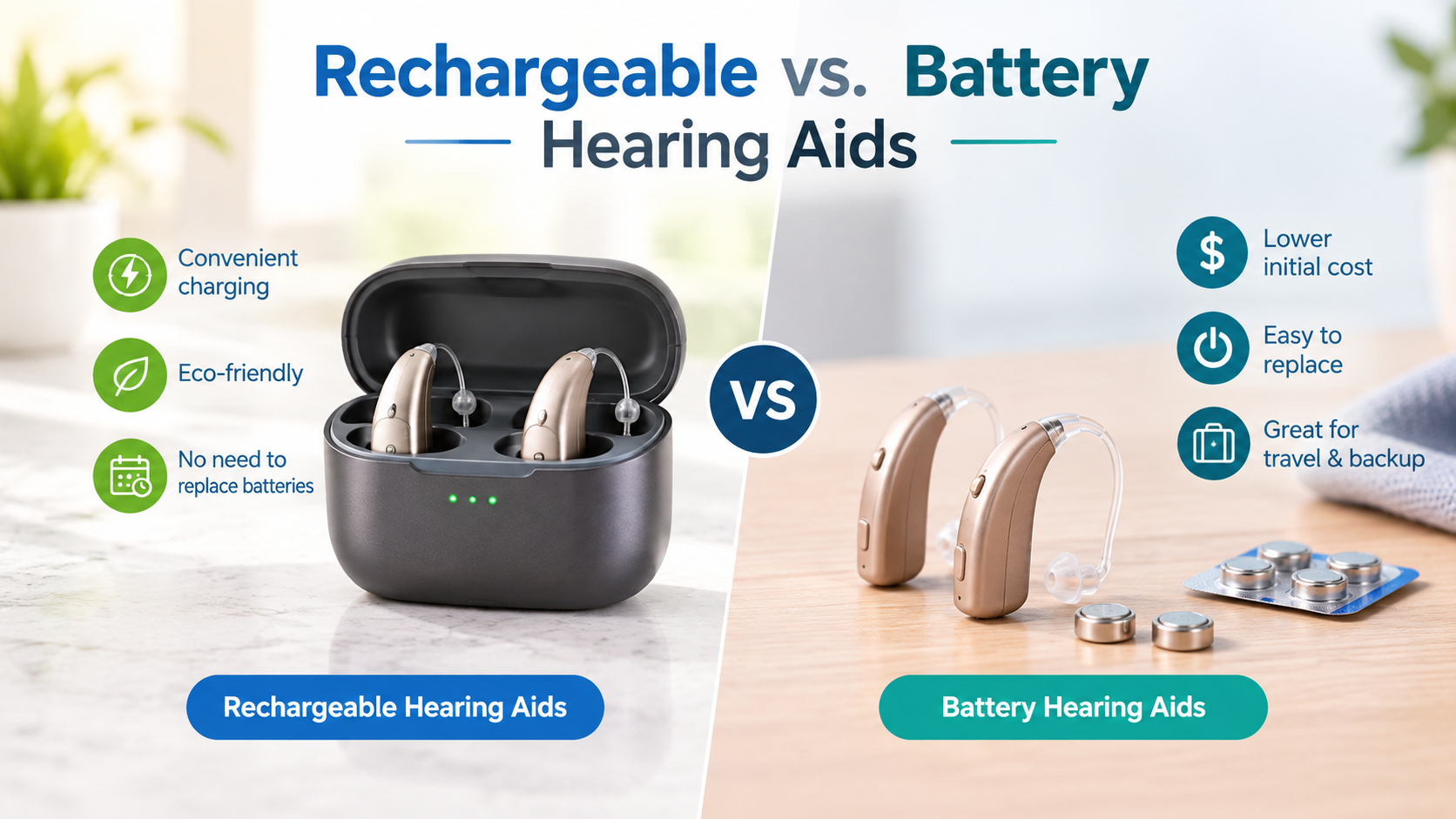
3. Rechargeability. Lithium-ion rechargeable models cost roughly ₹5,000 to ₹20,000 more than the battery version of the same device, but save you from buying batteries and fumbling with tiny doors. In 2026, rechargeable is the default on most mid and premium models.
4. Connectivity. Bluetooth streaming for calls, music and video, direct to Android and iPhone, adds cost. Newer LE Audio support is appearing on recent models and is worth asking about if you plan to keep the device 5 or more years.
5. AI and sensors. Deep neural network processors, motion sensors, fall detection, step counting and language translation sit on the highest tiers. They are impressive, but not essential for everyone.
6. Clinical service bundled in the price. In India, the price usually includes fitting, programming and some follow-ups. A cheaper device sold without service often costs more in the long run through poor fitting and wasted money.
7. Import duty, GST and exchange rate. Almost every premium device is imported. A weaker rupee or a new product launch can raise list prices, so quotes valid today may not hold in three months.
8. Your degree of hearing loss. Severe loss needs more powerful devices and sometimes custom earmoulds, which is another reason to avoid buying from a catalogue without a proper test.
Latest hearing aid trends in 2026 and what they mean for price
Hearing technology has changed more in the last three years than in the previous fifteen. Here is what is shaping prices and choices right now.
AI-powered sound processing. Every major brand now markets a deep neural network (DNN) chip trained on millions of real-world sound scenes. It separates speech from background noise far better than older rule-based systems. The result is clearer conversation in restaurants, markets and traffic, which is the main complaint Indian users report. Flagship AI models carry the highest prices, but the technology is filtering down to mid-range models each year, so last year’s flagship is often this year’s value buy.
LE Audio and Auracast. The newer Bluetooth LE Audio standard improves battery life and sound quality when streaming. Auracast lets hearing aids pick up broadcast audio in public venues such as airports, theatres and houses of worship, where venues have installed it. India’s rollout is early, so treat it as a future-proofing bonus, not a reason to overspend.
Rechargeable as standard. Most new mid and premium devices now run on lithium-ion batteries with a full day of use and a pocket charging case. This suits older users who struggle with tiny zinc-air cells, but check what happens when the battery ages, and whether the battery is replaceable.
Smartphone and tele-audiology. Brand apps let you adjust volume and programmes, and many audiologists now offer remote fine-tuning by video call. This is a real saving for people in smaller towns who live far from a centre, since each adjustment visit can cost travel money and a day off.
Health and wellness tracking. Step counts, activity tracking, fall detection and even heart-rate sensors are appearing in premium models. Research continues to link untreated hearing loss with higher risk of cognitive decline, so treating it early is increasingly seen as part of healthy ageing.
Over-the-counter (OTC) and earbud-based hearing features. In the United States, OTC hearing aids for mild to moderate loss became legal in 2022, and consumer earbuds now offer hearing-assist features. India does not have a formal OTC category yet, and availability of such features on specific phones and earbuds changes often, so check current specifications. These products may suit mild loss, but they are not a substitute for a proper test, especially if you have sudden loss, one-sided loss, ear pain or discharge.
Pricing outlook. Expect more competition at ₹25,000 to ₹60,000, where rechargeable, Bluetooth-ready devices are becoming common. Premium pricing is likely to stay high, because new chips and AI features are launched at the top first.
Hidden and ongoing costs most buyers miss
The sticker price is not the full cost of hearing better. Budget for these as well.
| Cost | Approx. amount (₹) | Notes |
|---|---|---|
| Hearing test (audiogram) | Free – 1,500 | Many clinics waive it if you buy; get a copy of the report |
| Custom earmould or ear impression | 500 – 3,000 per ear | For BTE power fits and custom styles |
| Batteries (non-rechargeable) | 150 – 400 per pack of 6 | Lasts about 5 to 14 days each cell, depending on size and use |
| Domes, wax guards, filters | 300 – 1,500 per year | Replaced every few months |
| Cleaning and dry kit | 500 – 3,000 | Important in humid or monsoon regions |
| Extended warranty | 5,000 – 20,000 | Typical standard warranty is 1 to 3 years |
| Repairs after warranty | 3,000 – 25,000 | Receiver and microphone failures are most common |
Lifespan and replacement. Plan for 5 to 7 years of use. Over that time, the cost per day of a ₹80,000 pair works out to roughly ₹30 to ₹45, less than a cup of coffee a day.
Tell-tale signs of a poor deal. The quote does not name the model or technology level. There is no written trial period or return policy. Follow-up visits are charged separately without being told up front. The seller only offers one brand and avoids showing you the audiogram.
GST. Hearing aids usually attract a low GST rate, but rates and notifications change. Make sure your invoice shows the GST separately and the model serial numbers, which you will need for warranty claims.
Government schemes, insurance and tax benefits
If cost is the main barrier, several routes can reduce or remove it. Rules and income limits are revised from time to time, so confirm current details with the official office before you apply.
ADIP scheme (Assistance to Disabled Persons). Run by the Department of Empowerment of Persons with Disabilities, this scheme provides aids and appliances, including hearing aids, through implementing agencies such as ALIMCO and through camps. Eligible people with a disability certificate (generally 40% or more) and a limited monthly income may receive devices free or at a subsidy. Camps are announced by district authorities and the agencies.
Children and cochlear implants. For young children with profound hearing loss, the government supports cochlear implant surgery through approved centres under national programmes. If your child was just diagnosed, ask the nearest government hospital or district early intervention centre about it as soon as possible, because early treatment makes a big difference to speech development.
Health insurance. Most standard policies exclude hearing aids as an “external device”. Some corporate plans and a few special policies cover them, so read the exclusions clause or ask your HR team. Surgeries such as cochlear implants may be covered under certain plans.
Tax benefits. The hearing aid purchase itself is not generally deductible. But a person with a certified disability may claim deductions under Section 80U, and the taxpayer supporting a disabled dependent may use Section 80DD. These need a valid disability certificate. Speak to a chartered accountant for your own case.
Other support. Some employers, trade unions, ESI, CGHS for central government staff and pensioners, and charitable trusts or NGOs give hearing aid support or refurbished devices. Many hospital audiology departments also run low-cost clinics.
If you are on a tight budget. A properly fitted basic digital aid from a registered audiologist usually beats a high-priced device bought without a test. Start with the best fitted device you can afford, and upgrade later when your needs or budget change.
How to buy a hearing aid in India without overpaying
Follow these steps in order. They protect both your money and your hearing.
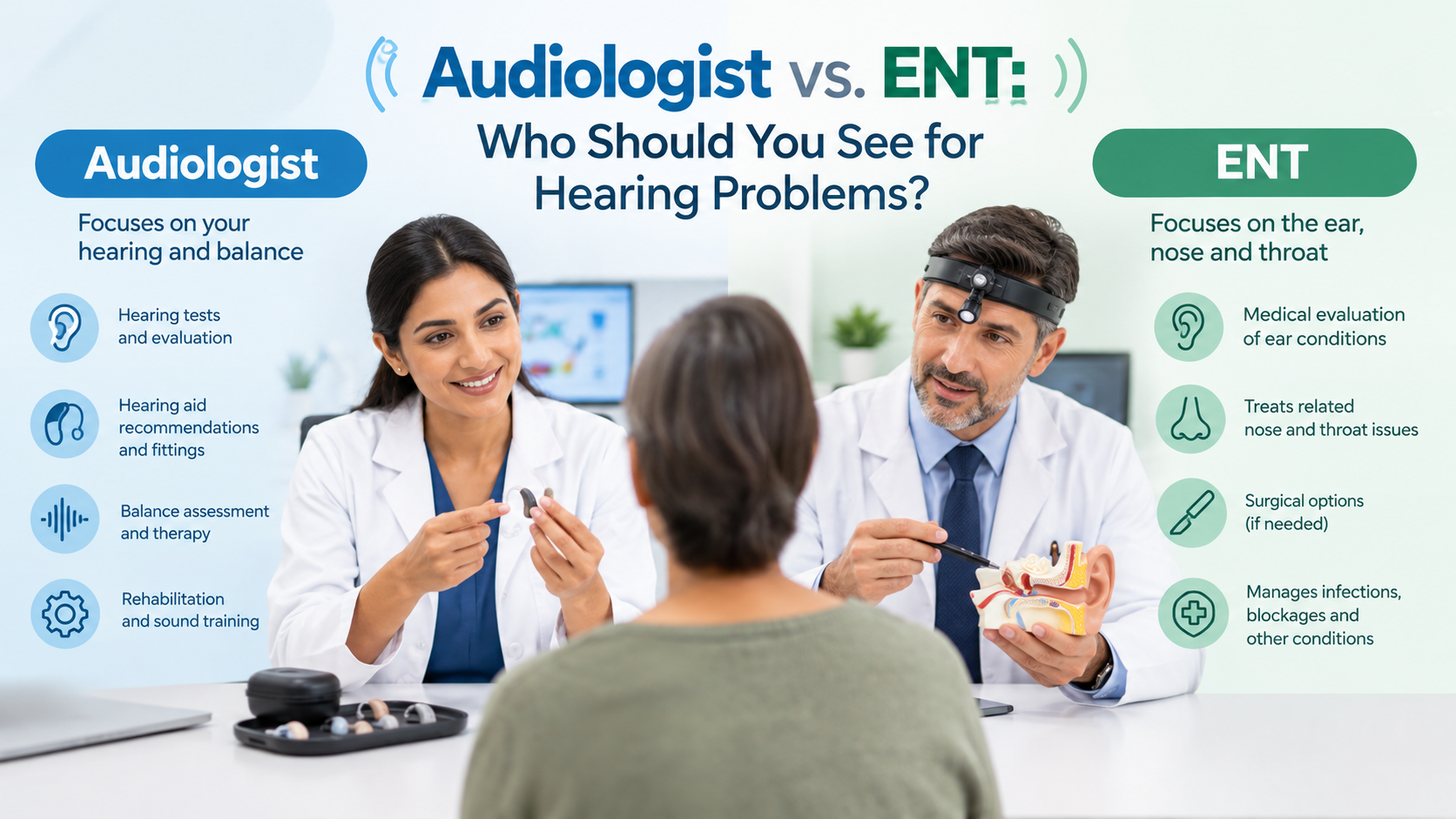
- Get a full hearing evaluation first. See an ENT doctor if you have pain, discharge, dizziness, ringing in one ear, or sudden or one-sided loss. These can signal conditions that need medical treatment, not a hearing aid.
- Visit an RCI-registered audiologist. The Rehabilitation Council of India maintains the register of qualified audiologists and speech-language pathologists. Ask to see the registration number.
- Describe your real life. Tell the audiologist about your work, noisy places, phone and TV habits, and who you talk to. A retired person who stays at home needs a different device from a sales executive.
- Ask for 2 or 3 options in different price bands. Request the model name, technology level, warranty and total cost in writing.
- Insist on a trial. A 15 to 30 day trial with a clear return or exchange policy is common at good clinics. Try the devices in your own noisy situations, not just the quiet clinic.
- Use real-ear measurement if available. Verification of the fitting, not just a software preset, is a mark of good practice.
- Compare total cost over 5 years. Include batteries, servicing and extended warranty, not only the purchase price.
- Give yourself time to adapt. Your brain needs 4 to 12 weeks to get used to sounds it has not heard for years. Wear the devices daily and attend follow-ups.
Online vs clinic. Buying online can be fine for accessories, batteries and trusted brand stores, but a hearing aid needs programming to your hearing loss. A device that arrives “ready to wear” without a test is a gamble. For most people, a clinic purchase with free follow-up is safer.
Buy one or two? If both ears have loss, two hearing aids generally give better speech understanding in noise and better sense of direction than one. If budget is tight, discuss options with your audiologist, such as buying the better ear first and adding the second later.
Red flags to walk away from. Pressure to decide today, claims of a “cure” or “invisible miracle” device, no audiogram, no model names, and discount offers that only apply on the same day.
Frequently asked questions
What is the cheapest hearing aid in India?
Basic body-worn and analog models start around ₹3,000 to ₹8,000, and government schemes can supply them free to eligible people. Entry-level digital behind-the-ear models start near ₹8,000 to ₹15,000.
What is the average cost of a hearing aid in India?
A reliable digital hearing aid typically costs ₹25,000 to ₹80,000 per ear. Most adults who buy a pair spend ₹60,000 to ₹1,50,000 in total.
Are hearing aids cheaper in India than abroad?
Entry and mid-level devices are usually cheaper in India, and premium devices are priced close to international levels after duty and GST. Warranty only applies to devices bought through authorised channels, so avoid parallel imports.
Does health insurance cover hearing aids in India?
Usually not. Most policies exclude them, though some corporate plans and special covers reimburse part of the cost. Check the policy wording.
Can I claim a tax deduction for a hearing aid?
Not directly in general. A person with a certified disability may qualify for deductions under Section 80U, and dependents’ expenses may qualify under Section 80DD. Consult a tax professional.
Which is the best hearing aid brand in India?
There is no single best brand. Major brands such as Phonak, Oticon, Signia, ReSound, Widex and Starkey all offer good technology. The audiologist’s skill and the quality of fitting matter as much as the brand.
How long do hearing aids last?
Usually 5 to 7 years with proper care. Receivers and microphones may need repair earlier, especially in humid regions.
Do I need two hearing aids?
If you have loss in both ears, two aids usually give clearer speech in noise and better sound localisation. Your audiologist can advise based on your test results.
Are rechargeable hearing aids worth the extra cost?
For most people, yes. They remove battery hassle and suit users with limited finger dexterity. Confirm whether the battery can be replaced when it ages.
Will a hearing aid restore normal hearing?
No. A hearing aid improves access to sound, especially speech, but it does not restore hearing the way glasses can restore sight. Realistic expectations and regular follow-ups lead to better results.
Can I try a hearing aid before buying?
Good clinics offer trial periods. Ask for the terms in writing before you pay.
Final thoughts: spend on the right fit, not the highest price
The cost of a hearing aid in India ranges from a few thousand rupees to over ₹2 lakh per ear, but the best value usually sits in the ₹30,000 to ₹90,000 per-ear zone, where you get modern digital processing, rechargeable convenience and good speech clarity. Paying more makes sense when you spend a lot of time in noisy places, need advanced streaming, or have a complex hearing loss. Paying less makes sense when your needs are simple, as long as the device is properly fitted by a qualified professional.
The most expensive mistake is not choosing a mid-range model. It is waiting. Untreated hearing loss affects relationships, work, safety and mental sharpness, and the brain adapts better when it is fitted sooner. A modestly priced device that you wear every day will always beat a premium device that sits in a drawer.
book a hearing test with a registered audiologist, bring a family member along, ask for a written quote and a trial period, and compare at least two options.