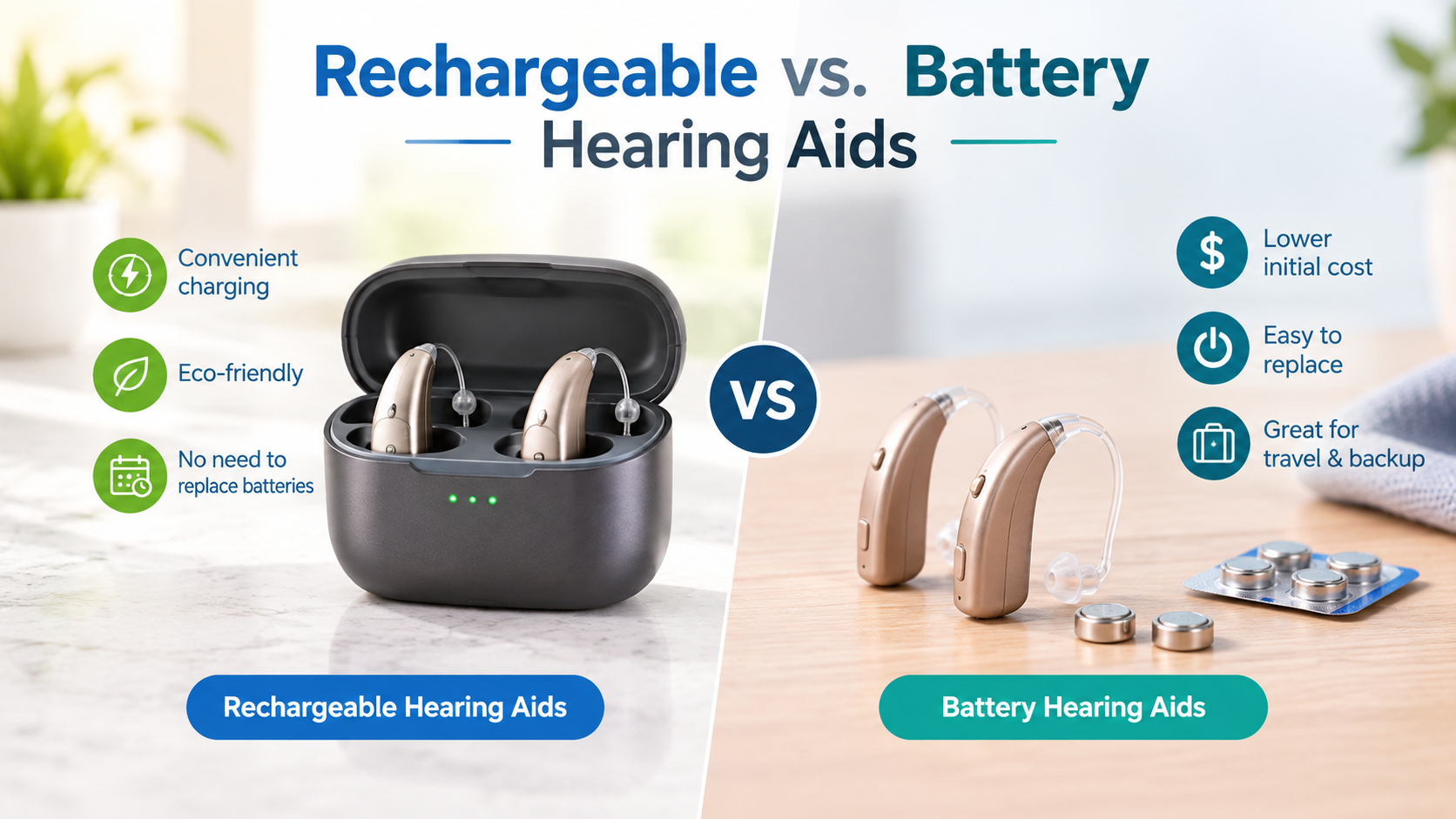
If you or someone in your family has recently been told, “You need a hearing aid,” the next question is usually about the technology. Should you buy a rechargeable hearing aid that you plug in every night or a traditional battery hearing aid that uses small disposable cells?
The question matters more in India than it might elsewhere. Power cuts in some regions, high humidity in coastal cities, dust, summer heat, long train journeys, joint families sharing one charging point, and strong price sensitivity all affect which option suits you.
This guide gives a plain answer. It covers how each type works, what each costs in rupees over several years, where each performs well or badly in Indian conditions, and who should choose which. It is written for first-time buyers, for adult children buying for aging parents, and for current users thinking of upgrading.
For most urban and semi-urban Indian users who have reliable electricity, are comfortable with simple routines, and want a more convenient experience, rechargeable hearing aids are usually the better choice today. Disposable-battery hearing aids are still the better choice for people with unreliable power, frequent travel to remote areas, limited dexterity needs that favor a simple swap, or a tighter upfront budget. The rest of this article explains why.
Quick Comparison at a Glance
| Factor | Rechargeable Hearing Aids | Disposable Battery Hearing Aids |
|---|---|---|
| Power source | Built-in lithium-ion or silver-zinc cell, charged in a case | Zinc-air button cells (sizes 10, 312, 13, 675) |
| Typical daily use per charge | About 16–30 hours, depending on model and streaming | Roughly 3–14 days per battery, depending on size and use |
| Recurring cost | Low (electricity); possible cell replacement after several years | Ongoing cost of battery packs |
| Upfront price | Often somewhat higher | Often somewhat lower for the same technology level |
| Ease for people with weak fingers or poor eyesight | Drop-in charging is easy | Tiny cells can be hard to handle |
| During a power cut | Needs a backup plan (power bank, spare charge) | Carry spare batteries and you are fine |
| Environmental impact | Fewer cells thrown away | Many used cells over the years |
| Best for | Daily users with steady electricity, tech-comfortable or elderly users who dislike changing cells | Users in low-power areas, frequent remote travellers, budget buyers |
How Each Type Works
Disposable (Battery) Hearing Aids
Most traditional hearing aids use zinc-air batteries. These are small button cells with a coloured sticker (yellow for size 10, brown for 312, orange for 13, and blue for 675). The cell activates when you peel the sticker and expose it to air. Once activated, it starts draining even if you are not wearing the device.
Smaller devices, such as completely-in-canal styles, use the smallest cells and drain them fast. Larger behind-the-ear devices for severe or profound hearing loss use bigger cells and last longer.
Rechargeable Hearing Aids
Rechargeable models contain a sealed cell inside the device. At night you place the hearing aids in a charging case or dock. By morning they are ready for a full day.
There are two main chemistries:
- Lithium-ion: Common in newer premium models. Small, powerful, and often supports fast charging, for example a short top-up charge that gives several hours of use.
- Silver-zinc: Used in some models. Some versions allow a removable rechargeable cell, which can be swapped out.
Many charging cases also act as portable chargers, with their own internal cell to top up the devices when you are away from a wall socket.
What Does Each Option Really Cost in India?
Price is the first concern for many Indian families, so this section looks at total cost rather than just the sticker price.
Typical Price Ranges (Indicative)
| Category | Approximate Range in India (per ear unless noted) |
|---|---|
| Basic analog or entry-level digital (battery) | ₹5,000 – ₹25,000 |
| Mid-range digital (battery) | ₹25,000 – ₹60,000 |
| Mid-range rechargeable | ₹40,000 – ₹90,000 |
| Premium rechargeable with Bluetooth and AI features | ₹80,000 – ₹180,000+ |
| Charging case or dock (if sold separately) | ₹3,000 – ₹15,000 |
These are broad market ranges, not quotes. Actual prices depend on brand, technology level, clinic, city and current offers. Always ask your audiologist for a written quotation.
Running Cost Over Five Years
Disposable batteries typically come in packs of six. A user wearing size 312 or 13 cells may use about one cell every 5–10 days per ear, depending on streaming and listening hours. Here is an illustration, not a guarantee.
| Cost Item | Battery Model (Both Ears) | Rechargeable Model (Both Ears) |
|---|---|---|
| Batteries used per year | Roughly 70–140 cells | None |
| Approx. yearly battery spend (assuming ₹25–₹60 per cell) | About ₹1,800 – ₹8,000 | Negligible |
| Electricity | None | Very small (a few rupees a month) |
| Cell replacement | Not applicable | Possible once in 4–6 years, depending on warranty and model |
| Five-year consumables estimate | About ₹9,000 – ₹40,000 | About ₹0 – ₹15,000 if replacement is needed |
Takeaway: Rechargeable models often cost more up front, but the gap can narrow over four to five years, especially for heavy users who stream calls and TV audio or who wear their hearing aids for 14+ hours a day. For light users on very basic devices, the difference may be small either way.
Hidden Costs to Ask About
- Warranty on the built-in cell. Ask how long the rechargeable cell is covered and what replacement costs.
- Charger replacement. If the case is lost or damaged, what does a new one cost?
- Service charges. Cleaning, wax guards, domes and tubing are needed for both types.
- Drying kit. Useful in humid cities such as Mumbai, Chennai, Kolkata, and Kochi, regardless of battery type.
Convenience and Daily Routine
Why Many Users Prefer Rechargeable
- No tiny cells to handle. For older adults with arthritis, tremors, reduced fingertip sensation, or poor vision, peeling a sticker off a 4 mm cell and inserting it correctly is genuinely hard.
- Simple nightly habit. Place them in the case, and they’re ready in the morning. It is similar to charging a phone.
- No surprise “dead battery” moments. Disposable cells often die at inconvenient times, such as in the middle of a family function or a business meeting.
- Sealed design. With no battery door, there is less opening for sweat, dust and moisture.
Why Some Users Prefer Disposable
- Instant swap. A dead battery takes 20 seconds to replace, and then you are back in action.
- No dependence on a charger. You never need to remember a cable or case.
- Predictable behavior. Many users are used to the system and don’t want to change habits.
- Lighter or smaller devices. Some very small custom devices still rely on disposable cells.
Performance in Indian Conditions
Most global reviews don’t address the realities Indian users face daily. This section does.
| Condition | Rechargeable | Disposable |
|---|---|---|
| Frequent power cuts (Tier 2/3 towns, rural areas) | Risky without backup. A power bank or inverter helps. | Safer. Keep spare cells in your bag. |
| Voltage fluctuations | Use a quality adapter or surge protector; avoid cheap chargers. | Not affected |
| High humidity and monsoon | Sealed designs help, but keep devices in a dry kit overnight. | Battery doors can let in moisture; zinc-air cells can fail early in damp air. |
| Extreme summer heat (North India) | Avoid charging in direct heat or leaving in a hot car; heat shortens cell life. | Heat can shorten battery life too; store cells in a cool place. |
| Dust and construction areas | Sealed units are advantageous. | Battery compartments can collect dust. |
| Long train or bus journeys | A charging case with built-in power helps if it has a power bank feature. | Carry spare cells; easy. |
| Pilgrimages, trekking, remote travel | Plan carefully; carry a power bank. | Usually simpler |
| Joint families with shared sockets | Easy to add a dedicated charging spot | No charging needed |
| Shops and clinics for battery access | Not required | Batteries are widely available in cities, but harder to find in small towns, and counterfeits exist |
A Note on Battery Quality
Cheap, unbranded button cells sold in local markets may be old stock or counterfeit. These can die in a day or two and cause frustration. Buy cells from your audiologist’s clinic or from authorized sellers and check the expiry date on the pack.
Battery Life and Charging Time
| Metric | Rechargeable | Disposable |
|---|---|---|
| Typical full charge or cell life | 16–30 hours of use (varies by model) | Size 10: ~3–7 days; Size 312: ~5–10 days; Size 13: ~8–14 days; Size 675: ~10–20 days (based on ~12–16 hours daily) |
| Full recharge time | Around 2–4 hours; fast charge options can give several hours of use in 30 minutes | Not applicable |
| Impact of Bluetooth streaming | Reduces runtime noticeably | Also drains batteries faster |
| Long-term ageing | Capacity gradually declines over years | Each new cell performs like new |
| Warning before shutdown | Usually a voice or sound alert | Most models give a low-battery beep, giving 1–5 minutes warning |
Important: Real-world battery life varies with the severity of hearing loss, the amount of amplification, noise-reduction features, wireless streaming, and daily wearing time. Your audiologist can estimate this based on your device.
Sound Quality: Does the Power Source Change the Hearing Experience?
No. The power source itself does not determine sound quality. What matters is:
- The technology level (processing channels, noise management, directionality)
- The fitting and programming by a qualified audiologist
- The receiver or speaker and the earmould or dome you use
- Your degree and type of hearing loss
A premium rechargeable and a premium battery model from the same brand often use the same processing chip. A basic battery model can sound better for you than a poorly fitted expensive rechargeable. A good fitting beats any battery type.
One practical point: rechargeable cells provide stable voltage until they are nearly empty, which means consistent performance across the day. Zinc-air cells can show a drop in performance toward the end of their life, though modern devices handle this well.
Features Typically Found in Rechargeable Models
Since many manufacturers now put their newest technology into rechargeable platforms first, these models often offer:
- Bluetooth streaming from smartphones, directly to the hearing aid
- Smartphone app control for volume, programs and tinnitus support
- Fall detection or activity tracking in some premium models
- Fast charging
- Remote adjustment by your audiologist through an app (tele-audiology)
If these features matter to you, the choice may effectively be made for you, because the most advanced models are increasingly rechargeable only. That said, several brands still offer battery versions of mid-range and basic models.
Environmental and Health Considerations
Environment
Disposable zinc-air cells are small, but across millions of users they add up. They are rarely recycled in India, and small cells often end up in household waste. A rechargeable model reduces this waste, though its built-in cell eventually needs proper e-waste disposal. Ask your clinic or the manufacturer whether they accept used devices and cells.
Safety
- Keep button cells away from children and pets. Swallowed button batteries are a medical emergency; seek immediate care.
- Rechargeable hearing aids from reputable brands pass safety standards. Avoid unbranded imports, since poor-quality lithium cells carry a heat risk.
- Charge only with the supplied charger and adapter.
Who Should Choose Rechargeable?
Rechargeable hearing aids are generally a good fit if you:
- Live in a city or town with mostly reliable electricity
- Wear your hearing aids for long hours daily
- Want Bluetooth, app control and modern features
- Have difficulty handling small batteries because of arthritis, vision issues or tremors
- Are buying for an elderly parent who needs a simple routine, and a family member can help set up the charging habit
- Want to avoid recurring battery purchases
- Are comfortable with phones and charging routines
Who Should Choose Disposable?
Battery hearing aids are often a better fit if you:
- Live in an area with frequent or long power cuts
- Travel regularly to remote areas, villages or hill regions
- Need an extremely low upfront budget
- Prefer the swap-and-go convenience of a spare cell
- Have a severe or profound hearing loss and use a powerful behind-the-ear device that benefits from larger batteries
- Are an occasional user and don’t need all-day wear
- Are already comfortable with disposable cells and don’t want to change habits
Decision Guide
| Your Situation | Better Choice | Why |
|---|---|---|
| Retired parent in a metro, uses a smartphone | Rechargeable | Easy routine, streaming calls and TV |
| Elderly relative in a village with frequent outages | Battery | Reliable without grid power |
| Working professional in meetings all day | Rechargeable (with fast charge) | Reliable all-day power, discreet charging |
| Student with limited budget | Battery (entry-level) or government-supported options | Lower upfront cost |
| Frequent traveller by train | Either; rechargeable with power-bank case, or battery with spares | Depends on trip length |
| Person with arthritis or vision problems | Rechargeable | No small cells to handle |
| Heavy phone-call and streaming user | Rechargeable | Streaming drains cells fast; recharge daily |
| Severe or profound loss | Battery power BTE, or a powerful rechargeable BTE | Depends on model; consult audiologist |
Practical Tips for Indian Users
If You Choose Rechargeable
- Use a surge-protected socket. Voltage fluctuations can damage chargers.
- Keep a backup plan. A small power bank can charge many cases through USB.
- Charge overnight in a cool, dry room. Avoid leaving devices near windows in summer.
- Dry them first. Wipe off sweat and moisture before docking.
- Check the warranty. Know what happens if the cell weakens before the warranty ends.
- Update the family. Make sure a caregiver knows how to place the devices correctly in the charger.
If You Choose Disposable
- Buy from trusted sources. Check the expiry date.
- Wait a minute after peeling the sticker. Letting the cell “breathe” for about a minute before inserting improves performance.
- Store spares at room temperature. Do not keep them in the fridge or in a hot bag.
- Open the battery door at night. This lets moisture escape and saves cell life.
- Carry a spare pack. Keep at least two cells per ear in your pocket or bag.
- Dispose of used cells carefully. Tape over them and keep away from children.
For Both Types
- Clean devices daily with a soft, dry brush or cloth.
- Replace wax guards and domes as advised.
- Store in a drying box during monsoon or in coastal cities.
- Get a professional check every 3–6 months.
- Avoid water, hair spray and perfume contact.
Government Schemes and Support in India
Cost is a barrier for many families. A few support routes to explore:
- ADIP Scheme (Assistance to Disabled Persons): Under the central government scheme, eligible persons with hearing disability can receive aids and appliances at low or no cost through authorised agencies. Eligibility depends on disability certification and income criteria.
- ALIMCO (Artificial Limbs Manufacturing Corporation of India): A public-sector body that has supplied hearing aids under government programmes, often through camps.
- State welfare departments and district disability rehabilitation centres: Many run camps and subsidised programmes.
- Employer or insurance benefits: Some corporate policies partially cover hearing devices, though regular health insurance often does not.
- CSR and NGO programmes: Several charities and hospital trusts offer discounted or free devices.
Government-supplied devices are usually battery-operated, basic models. Policies and eligibility change, so confirm the current rules with your district disability office or an official portal before applying.
How to Buy: A Step-by-Step Checklist
- Get a hearing test first. Visit a qualified audiologist, ideally one registered with the Rehabilitation Council of India (RCI). Avoid buying based only on an online ad or a camp without a proper audiogram.
- Get medical clearance if needed. An ENT specialist should rule out wax, infection or medically treatable causes, especially if the hearing loss is sudden or one-sided. Sudden hearing loss needs urgent medical attention.
- Discuss your lifestyle. Tell the audiologist about work, noise, phone use, travel and who will help with maintenance.
- Ask for a trial period. Many reputable clinics offer a home trial. Use the devices in real settings, such as markets, family gatherings and the phone.
- Compare in writing. Get quotations for both a rechargeable and a battery version of the same technology level.
- Check warranty and service terms. Ask about loss-and-damage cover, repair time and loaner devices.
- Plan the follow-up. Fine-tuning visits are essential during the first few weeks.
Common Myths
| Myth | Reality |
|---|---|
| “Rechargeable hearing aids sound better.” | Sound quality depends on technology and fitting, not the power source. |
| “Rechargeable cells last forever.” | Their capacity declines over several years; plan for eventual replacement. |
| “Battery models are outdated.” | They remain reliable, widely available and well suited to many users. |
| “Any cheap online hearing amplifier is the same as a hearing aid.” | Personal sound amplifiers are not fitted to your hearing loss and can be ineffective or even harmful. |
| “Charging overnight damages the device.” | Modern chargers stop charging when the cell is full. |
| “I can use any phone charger.” | Use the supplied charger or one the manufacturer recommends. |
Frequently Asked Questions
1. Are rechargeable hearing aids worth it in India?
For many urban users, yes. They reduce recurring costs, simplify daily use and typically offer newer features. If you face frequent power cuts or have a tight budget, a battery model may be wiser.
2. How long do rechargeable hearing aid batteries last before needing replacement?
It varies by model and usage, but many built-in cells are designed to last several years. Warranty coverage varies, so ask the clinic for details in writing.
3. What happens if the power goes out and my hearing aids are not charged?
Use a power bank with a compatible charging case, or a fast-charge function if available. If you rely on unreliable electricity, a disposable-battery model or a spare-battery plan may be safer.
4. Can I switch from battery to rechargeable later?
Usually you would need a different model, since most devices are built for one type. A few models are available in both versions, and some battery models can be converted with an accessory battery door, depending on the brand.
5. Which is better for elderly people?
Rechargeable is often easier for people with limited dexterity or vision, provided a family member helps establish the routine. If they live in an area with unstable electricity, battery models may still be the practical choice.
6. Do rechargeable hearing aids work for severe hearing loss?
Yes, many powerful behind-the-ear models are now available in rechargeable versions. Your audiologist can check what suits your audiogram.
7. How should I dispose of old hearing aid batteries in India?
Do not burn or crush them. Ask the clinic about collection options, or take them to an e-waste or battery recycling centre if one is available locally.
8. Are rechargeable hearing aids safe for children?
Many are designed with tamper-resistant compartments, which also reduces the risk of children swallowing button cells. Your paediatric audiologist can advise on the best option.
9. Do I need a different hearing aid in humid cities?
Look for models with a good ingress protection rating (IP rating) and use a drying kit. This applies to both types.
10. Should I buy online?
Be cautious. Hearing aids need to be programmed to your hearing loss and checked in person. If you do buy online, ensure the seller is authorised and that a qualified audiologist will fit and support the device.
Final Verdict
There is no single winner for everyone, but the pattern is clear.
- Choose rechargeable if you want convenience, modern features and lower long-term running costs, and you have fairly reliable electricity. For most urban Indian users, especially older adults who struggle with small cells and people who stream calls and media, this is the stronger option today.
- Choose disposable batteries if you live with frequent power cuts, travel to remote places, need the lowest upfront price, or rely on a powerful device where battery models remain practical.
Whichever you choose, remember that the quality of the fitting, regular follow-up care and consistent daily use matter more than the battery type. A well-fitted hearing aid that you wear every day will do far more for your hearing, relationships and safety than any feature on a spec sheet.
Before you buy, book a hearing evaluation with a qualified audiologist, try both options if possible, and ask for a trial period. That is the most reliable way to find which is better for you.