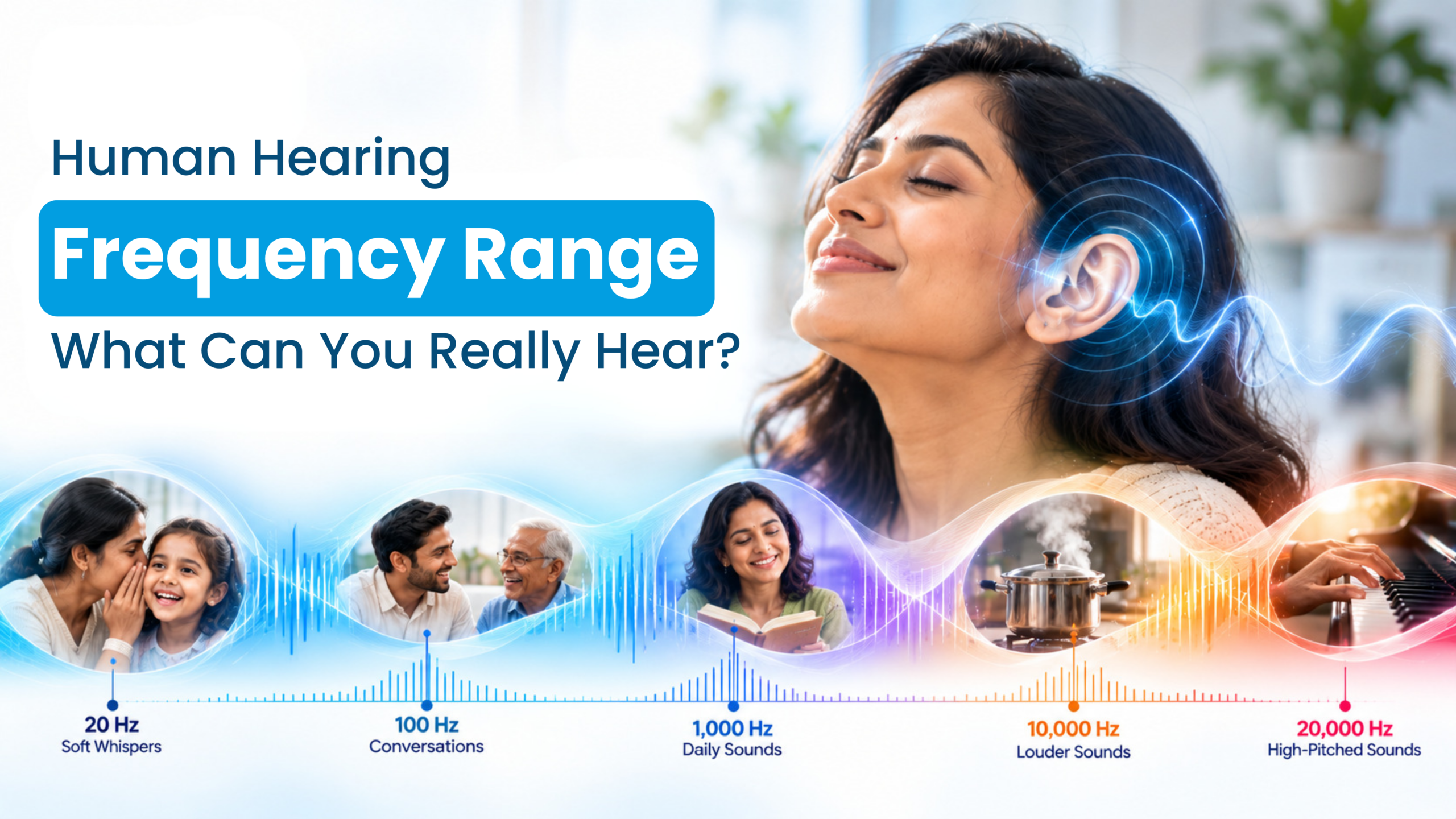
The human hearing frequency range is about 20 Hz to 20,000 Hz (20 kHz). That is the span of pitches a healthy young person can detect, from the deepest rumble of thunder to the thinnest, highest shimmer of a cymbal.
Three things are worth knowing straight away:
- Lowest pitch you can hear: roughly 20 Hz.
- Highest pitch you can hear: roughly 20,000 Hz in childhood, but most adults top out nearer 15,000–17,000 Hz.
- Where hearing is sharpest: between about 2,000 and 5,000 Hz, the zone where speech consonants live.
Below 20 Hz is called infrasound. Above 20,000 Hz is called ultrasound. Your ears are not built to turn either into a clear sense of pitch.
If you came here for a fast answer, you have it. If you want to understand why the range is what it is, how it changes with age, how loud sounds must be before you notice them, what animals hear, and how to protect what you have, keep reading.
Human Hearing Frequency Range at a Glance
Here is the whole topic compressed into one table. Bookmark it.
| Feature | Typical Value | What It Means |
|---|---|---|
| Normal hearing range | 20 Hz – 20,000 Hz | The textbook range for healthy young ears |
| Lowest audible pitch | ~20 Hz | Deep bass you feel as much as hear |
| Highest audible pitch (children/teens) | ~18,000–20,000 Hz | Very high, thin tones |
| Highest audible pitch (typical adult) | ~15,000–17,000 Hz | Declines with age and noise exposure |
| Most sensitive region | ~2,000–5,000 Hz | Speech clarity, alarms, baby cries |
| Speech range tested in clinics | 250 Hz – 8,000 Hz | The core of a standard hearing test |
| Quietest sound detectable | ~0 dB SPL (at ~1,000 Hz) | The “threshold of hearing” |
| Dynamic range | ~120–130 dB | From faintest sound to pain threshold |
| Width of the range | ~10 octaves | Each octave is a doubling of frequency |
| Below the range | Under 20 Hz | Infrasound |
| Above the range | Over 20,000 Hz | Ultrasound |
What Is Frequency, and What Is a Hertz?
Sound is vibration. When a guitar string, a loudspeaker cone, or your vocal cords move back and forth, they push the air around them into alternating zones of slightly higher and lower pressure. Those pressure waves travel outward until they reach your ear.
Frequency is how many of those back-and-forth cycles happen each second. It is measured in hertz (Hz), named after the German physicist Heinrich Hertz.
- 1 Hz = one cycle per second.
- 1 kilohertz (kHz) = 1,000 cycles per second.
- 20 Hz = 20 cycles per second.
- 20 kHz = 20,000 cycles per second.
Your brain interprets frequency as pitch. Low frequencies sound deep, like a bass drum or a tuba. High frequencies sound bright or shrill, like a piccolo or a squeaky hinge.
Frequency, wavelength and why it matters
Sound travels through air at about 343 meters per second at room temperature. Because wavelength equals speed divided by frequency, you can work out how long a sound wave is:
| Frequency | Approximate Wavelength in Air | Real-World Feel |
|---|---|---|
| 20 Hz | ~17 meters (56 ft) | Longer than a bus |
| 100 Hz | ~3.4 meters (11 ft) | Room-filling bass |
| 1,000 Hz | ~34 cm (13 in) | Mid-range voice |
| 10,000 Hz | ~3.4 cm (1.3 in) | Sharp treble |
| 20,000 Hz | ~1.7 cm (0.7 in) | Smaller than your thumb |
This is one reason bass is so hard to control in a room. Waves 17 meters long wrap around walls and furniture, while 1.7 cm waves are easily blocked by a curtain.
Frequency is not volume.
A common mix-up: frequency is pitch, not loudness. A tiny whistle and a huge siren can share the same frequency, yet one is far louder. Loudness is measured in decibels (dB) and relates to the amplitude, or strength, of the wave. We will cover both, because the human hearing frequency range only makes sense when you also understand how loud a sound has to be before you can hear it.
How Your Ear Turns Vibrations Into Pitch
To understand why the range stops at 20 Hz and 20 kHz, it helps to follow a sound wave on its journey through your ear.
1. The outer ear
The visible part of your ear, the pinna, funnels sound into the ear canal. The canal is a tube about 2.5 cm long. Like an organ pipe, it resonates, which boosts frequencies in the 2,000–5,000 Hz region by roughly 10–15 dB. This single piece of anatomy is a major reason your hearing is most sensitive in that band.
2. The middle ear
At the end of the canal sits the eardrum (tympanic membrane). Sound waves make it vibrate. Behind it, three tiny bones, the malleus, incus and stapes (hammer, anvil, and stirrup), act as a lever system. They pass the vibration along and amplify it, matching the airborne sound to the fluid-filled inner ear. Without this impedance matching, most of the sound energy would simply bounce off.
3. The inner ear and the cochlea
The stapes pushes on the oval window, creating waves in the fluid inside the cochlea, a snail-shaped structure about the size of a pea. Inside runs the basilar membrane, a flexible strip that is:
- Narrow and stiff near the base (entrance), so it responds best to high frequencies.
- Wide and floppy near the apex (tip), so it responds best to low frequencies.
This arrangement is called tonotopic organization: each position along the membrane is tuned to a particular pitch, like keys on a piano.
4. Hair cells and the auditory nerve
Resting on the basilar membrane are roughly 3,500 inner hair cells and about 12,000 outer hair cells. Tiny hair-like bundles on top bend as the membrane moves. That bending opens channels and generates electrical signals. The inner hair cells send these signals up the auditory nerve to the brain. The outer hair cells act as biological amplifiers, sharpening your frequency tuning.
5. The brain
The auditory cortex decodes the pattern of signals into pitch, loudness, direction, and meaning. A beautiful part of this system is that your brain combines place (which part of the cochlea fired) with timing (the rhythm of nerve firing) to judge pitch, especially at lower frequencies.
Why the limits exist
The edges of the range come from physical and biological constraints:
- At the low end (~20 Hz): The ear’s mechanics become inefficient for very slow vibrations. Below this, sounds also stop blending into a smooth tone and start to be felt as individual pulses or as body vibration.
- At the high end (~20 kHz): The stiff base of the basilar membrane can only respond up to a certain frequency, and the tiny hair cells there are the most vulnerable to wear and damage. Nerve firing also has speed limits.
Evolution tuned our ears to the sounds that mattered most for survival and communication: voices, footsteps, calls and environmental cues, not bat squeaks or earthquakes.
The Hearing Spectrum, Band by Band
Audio engineers, musicians and audiologists often divide the range into bands. The boundaries are conventions rather than hard laws, but they are useful.
| Band | Frequency Range | Character | Examples |
|---|---|---|---|
| Sub-bass | 20 – 60 Hz | Felt more than heard | Deep organ notes, explosions, big subwoofers |
| Bass | 60 – 250 Hz | Warmth, weight, power | Kick drum, bass guitar, male voice fundamentals |
| Low mids | 250 – 500 Hz | Body, fullness | Lower guitar and piano tones, “boxy” sounds |
| Mids | 500 – 2,000 Hz | Core of vowels and instruments | Most of the voice, snare drum body |
| Upper mids/presence | 2,000 – 4,000 Hz | Clarity, intelligibility, bite | Consonants like “s,” “t,” “k”; baby cries |
| Brilliance / treble | 4,000 – 6,000 Hz | Sharpness, definition | Cymbal attack, sibilance |
| Air / extended highs | 6,000 – 20,000 Hz | Sparkle, space, airiness | Cymbal shimmer, breath on vocals, “sizzle” |
Low frequencies (20–250 Hz)
These carry power and emotion in music and film. They also carry less of the information needed to understand speech. You can mute almost everything below 250 Hz and still follow a conversation, although the voice will sound thin.
Mid frequencies (250–4,000 Hz)
This is the heartland of human communication. The fundamental pitch of a typical adult male voice is about 85–180 Hz, and an adult female voice about 165–255 Hz. But the energy that makes words intelligible sits higher, in the harmonics and consonant sounds that stretch into the thousands of hertz.
High frequencies (4,000 – 20,000 Hz)
High frequencies add detail, brightness, and a sense of space. They are also the first to go as we age or when we are exposed to damaging noise.
Why We Hear Some Frequencies Better Than Others
Here is a surprise: the “20 to 20,000 Hz” range does not mean all frequencies sound equally loud. Your ear is far more sensitive in some zones than in others.
The absolute threshold of hearing
The threshold of hearing is the quietest sound you can detect at each frequency. At about 1,000 Hz, a healthy ear can notice sounds around 0 dB SPL (a pressure of about 20 micropascals). But at 50 Hz, a sound needs to be perhaps 40 to 50 dB higher before you can hear it. At 15,000 Hz, it needs a similar boost.
Plot this and you get a U-shaped curve, with the sweet spot in the middle and a steep climb at both ends.
Equal-loudness contours
Researchers Harvey Fletcher and Wilden Munson first mapped how loudness perception changes with frequency, and the standard has since been refined (it is now described in the international standard ISO 226). The resulting equal-loudness contours show:
- At quiet listening levels, bass and very high treble seem to disappear.
- At loud levels, the contours flatten and the sound feels more balanced.
That is why music sounds “thin” at low volume and why many amplifiers once included a “loudness” button that boosts bass and treble.
Where sensitivity peaks
| Frequency Zone | Relative Sensitivity | Why |
|---|---|---|
| Below 100 Hz | Low | Ear mechanics are inefficient; sounds need high levels |
| 100 – 1,000 Hz | Moderate to good | Voice fundamentals, most music |
| 2,000 – 5,000 Hz | Highest | Ear canal resonance; speech consonants |
| 5,000 – 10,000 Hz | Moderate | Declining sensitivity |
| 10,000 – 20,000 Hz | Low | Needs high levels; vulnerable to loss |
The peak is no accident. A baby’s cry, a smoke alarm and the consonants that distinguish “sat” from “fat” all sit in the zone where we are most alert.
Human Hearing Range by Age
The headline range of 20 Hz to 20 kHz applies to healthy young people. The upper limit shrinks across life, a process known as presbycusis (age-related hearing loss).
Typical upper hearing limit by age
| Age Group | Approximate Upper Limit | Notes |
|---|---|---|
| Newborns and young children | ~20,000 Hz or slightly higher | Best high-frequency hearing of any age |
| Teenagers | ~17,000 – 19,000 Hz | Can often hear “mosquito” ringtones in the high-teens kHz |
| 20s – 30s | ~15,000 – 17,000 Hz | Gradual, often unnoticed decline begins |
| 40s | ~13,000 – 16,000 Hz | High-pitched sounds start to fade |
| 50s | ~12,000 – 14,000 Hz | Many people notice difficulty with consonants |
| 60s | ~10,000 – 12,000 Hz | Speech in noise becomes harder |
| 70+ | ~8,000 – 10,000 Hz or lower | Wide individual variation |
These are typical figures, not guarantees. Genetics, noise exposure, medications, illness and lifestyle all change the picture. Your own results can be better or worse.
Why high frequencies fade first
Several things combine:
- Wear on the base of the cochlea. The high-frequency hair cells sit at the entrance, where they are hit first and hardest by every sound wave.
- No regrowth. In humans, damaged cochlear hair cells do not regenerate.
- Cumulative noise. Years of traffic, headphones, power tools and concerts add up.
- Reduced blood supply and nerve changes. These come with ageing.
Does gender matter?
Studies often find that men’s high-frequency hearing declines somewhat faster than women’s on average. A major reason is historical: men have been more likely to work in loud occupations or to be exposed to firearms and machinery. Hormonal and genetic differences may also play a role, and some research suggests women’s hearing can drop more steeply after menopause. Overall, though, differences between individuals are far bigger than differences between sexes.
What you lose, and what you keep
Losing the top few kilohertz does not mean silence. Many adults who cannot hear above 12 kHz still hear music and speech well. The practical problems begin when loss moves into the 2,000–8,000 Hz band, because that is where speech clarity lives. People then say, “I can hear you, but I can’t understand you,” especially in restaurants or crowds.
Frequency vs. Loudness: The Decibel Side of Hearing
A full picture of human hearing needs two axes:
- Frequency (pitch): roughly 20 Hz to 20,000 Hz.
- Intensity (loudness): roughly 0 dB to 120–130 dB.
What is a decibel?
The decibel is a logarithmic unit. An increase of 10 dB means the sound energy is 10 times greater, and it is perceived as roughly “twice as loud.” That compresses a gigantic range into manageable numbers. The loudest sound you can tolerate carries around a trillion times more energy than the faintest one you can detect.
Common sound levels
| Sound | Approximate Level | Safe Exposure Guidance |
|---|---|---|
| Threshold of hearing | 0 dB | Safe |
| Rustling leaves | 10 dB | Safe |
| Whisper | 30 dB | Safe |
| Quiet library | 40 dB | Safe |
| Normal conversation | 60 dB | Safe |
| Busy restaurant | 70 – 80 dB | Safe for hours |
| City traffic (inside car) | 80 – 85 dB | Prolonged exposure approaches the limit |
| Lawn mower, blender | 85 – 90 dB | Limit exposure to a few hours |
| Motorcycle | 95 – 100 dB | Minutes to an hour; use protection |
| Concert, nightclub | 100 – 110 dB | Short exposure only; use earplugs |
| Ambulance siren, chainsaw | 110 – 120 dB | Risk of damage within minutes |
| Gunshot, fireworks at close range | 140+ dB | Instant damage possible |
The 85 dB rule
Occupational safety agencies commonly use 85 dB averaged over 8 hours as a threshold above which hearing protection and monitoring are recommended. Each time the level rises by about 3 dB (using the more conservative NIOSH rule), the safe time halves. So 88 dB is safe for about 4 hours, 91 dB for 2 hours, and 100 dB for only about 15 minutes.
Putting frequency and loudness together
An audiogram plots hearing thresholds across frequency (left to right) and loudness (top to bottom). Normal hearing sits near the top of the chart (quiet sounds are detected). The farther a line falls, the louder a sound must be before you hear it. Audiologists use the audiogram to measure and describe loss precisely.
Everyday Sounds and Where They Sit on the Scale
Seeing familiar sounds on the frequency scale makes the abstract numbers feel real.
| Sound | Approximate Frequency |
|---|---|
| Rumble of distant thunder, large subwoofer | 20 – 100 Hz |
| Lowest note on a piano (A0) | 27.5 Hz |
| Lowest note on a standard 4-string bass guitar (E1) | ~41 Hz |
| Adult male speaking voice (fundamental) | ~85 – 180 Hz |
| Adult female speaking voice (fundamental) | ~165 – 255 Hz |
| Middle C on a piano | ~262 Hz |
| Concert pitch A4 (tuning note) | 440 Hz |
| Mosquito wing beat | ~400 – 600 Hz |
| Most vowel sounds (key resonances) | ~300 – 3,000 Hz |
| Telephone voice band (traditional landline) | ~300 – 3,400 Hz |
| Speech consonants (s, f, th, t, k) | ~2,000 – 8,000 Hz |
| Highest note on a piano (C8) | ~4,186 Hz |
| Smoke alarm beeps | ~3,000 – 3,500 Hz |
| Many birdsongs | ~1,000 – 8,000 Hz |
| Cymbal shimmer | ~3,000 – 15,000 Hz |
| “Mosquito” anti-loitering tone | ~17,000 Hz |
| CD audio upper limit (Nyquist) | 22,050 Hz |
A few lessons jump out:
- The entire range of a piano (27.5 Hz to about 4,186 Hz) uses only a fraction of your hearing range. The fundamentals of nearly all music fit in the lower half, with harmonics reaching into the upper range to give instruments their character.
- Traditional phone lines cut everything below 300 Hz and above about 3,400 Hz, yet we still recognize voices. This shows how redundant speech information is.
- Your best hearing zone covers the “important” sounds like alarms and baby cries by design.
Infrasound and Ultrasound: Sounds Beyond the Range
Infrasound (below 20 Hz)
Infrasound is too low in frequency for most people to hear as a tone, although at very high levels it can be felt as pressure or vibration. Natural and man-made sources include:
- Earthquakes and volcanic eruptions
- Ocean waves and storms
- Wind over mountains
- Large machinery and ventilation systems
- Some animals, such as elephants and whales, use infrasonic calls to communicate across long distances
Researchers continue to study how very low-frequency noise affects comfort and wellbeing. While folklore links infrasound to feelings of unease, the evidence for dramatic effects at everyday levels is limited, and findings are still debated.
Ultrasound (above 20,000 Hz)
Ultrasound has frequencies above what humans can normally hear. It is one of the most useful technologies in modern life:
| Application | Typical Frequency |
|---|---|
| Medical imaging (pregnancy scans, heart echo) | 2 – 18 MHz (millions of Hz) |
| Physiotherapy ultrasound | ~1 – 3 MHz |
| Ultrasonic cleaning baths | ~20 – 400 kHz |
| Pest-repellent devices | ~20 – 65 kHz |
| Parking sensors | ~40 – 70 kHz |
| Bat echolocation | ~20 – 200 kHz |
| Dog whistles | ~23 – 54 kHz |
Can humans ever hear ultrasound?
Under special conditions, the answer is partly yes:
- Bone conduction: Ultrasound applied directly to the skull can produce a sense of hearing in some people, even those with severe hearing loss, because vibrations reach the cochlea without passing through the air.
- Children and young adults: Some can hear tones just beyond 20 kHz if the sound is loud enough.
- Distortion: Loud ultrasound can create audible by-products in equipment or in the ear itself.
High-intensity ultrasound is not harmless. Very strong ultrasonic sound can cause discomfort and, at high enough levels, may damage hearing, so safety limits exist for occupational exposure.
Human Hearing vs. Animal Hearing
Humans are good listeners, but not record holders. Many animals hear higher, lower or both.
Approximate hearing ranges
| Species | Approximate Hearing Range | Notes |
|---|---|---|
| Humans | 20 Hz – 20 kHz | Tuned for speech |
| Dogs | ~67 Hz – 45 kHz | Range varies by breed and age |
| Cats | ~48 Hz – 85 kHz | Superb high-frequency hearing for hunting rodents |
| Horses | ~55 Hz – 33 kHz | Mobile ears help locate sounds |
| Cows | ~23 Hz – 35 kHz | Sensitive to a wide range |
| Rabbits | ~96 Hz – 49 kHz | Detect predators early |
| Mice and rats | ~1 kHz – 70+ kHz | Communicate with ultrasound |
| Bats | up to 100+ kHz | Echolocation |
| Dolphins | ~75 Hz – 150 kHz | Biosonar |
| Elephants | ~16 Hz – 12 kHz | Use infrasonic rumbles |
| Birds (most species) | ~200 Hz – 8,000+ Hz | Narrower range, excellent timing |
| Goldfish | ~100 Hz – 2 kHz | Hear through water and swim bladder |
Values are approximate and vary by study and method.
Why do animals differ?
- Head and ear size. Small heads favor high-frequency hearing, because localizing sound relies on tiny time and level differences between ears. Large animals, with ears far apart, can use lower frequencies.
- Hunting and survival needs. Cats and bats evolved to find small, high-pitched prey sounds.
- Communication. Elephants and some whales use deep calls that carry for kilometers.
What this means for pet owners
If you own a dog or cat, ultrasonic noise from some electronics, cleaning devices or pest repellers may be audible and uncomfortable for them even though it is silent to you. Rather than guess, watch for signs like ear flicking, avoidance or restlessness when a device is on.
How Hearing Is Tested
If you ever wonder where your personal range stands, professionals have reliable ways to measure it.
Pure-tone audiometry
The standard test. In a quiet booth, you wear headphones and press a button whenever you hear a beep. The audiologist plays tones at different frequencies and finds the quietest level you can detect at each.
- Standard frequencies tested: 250, 500, 1,000, 2,000, 4,000 and 8,000 Hz (and sometimes 3,000 and 6,000 Hz).
- Results are plotted on an audiogram in dB HL (hearing level).
Extended high-frequency audiometry
Some clinics and research settings test 8,000 to 16,000 Hz (and sometimes higher). This can reveal early noise damage or the effects of certain medications before it shows up in the standard range.
Other common tests
| Test | What It Measures |
|---|---|
| Speech audiometry | Ability to hear and repeat words, in quiet and in noise |
| Tympanometry | Eardrum movement and middle-ear function |
| Otoacoustic emissions (OAE) | Outer hair cell health; used for newborn screening |
| Auditory brainstem response (ABR) | Neural response to sound; useful for infants |
| Bone conduction testing | Whether loss is in the outer/middle ear or the inner ear |
Degrees of hearing loss
Classification systems differ slightly between organizations, but a commonly used scheme looks like this:
| Degree | Average Threshold (dB HL) | What You May Notice |
|---|---|---|
| Normal | Up to ~20 – 25 | Hears soft sounds clearly |
| Mild | ~26 – 40 | Difficulty with whispers and noisy rooms |
| Moderate | ~41 – 55 | Struggles with normal conversation |
| Moderately severe | ~56 – 70 | Needs raised voices or amplification |
| Severe | ~71 – 90 | Hears only very loud sounds |
| Profound | 91+ | Little or no usable hearing without technology |
Can You Test Your Own Hearing Range at Home?
Online tone generators and smartphone apps can give a fun, rough idea of your upper and lower limits, but they come with big caveats.
How to do a rough self-check
- Use good headphones (not laptop speakers, which cannot reproduce very low or very high tones).
- Choose a quiet room.
- Start with the volume low, then raise it gradually to a comfortable level. Never blast a test tone.
- Play a sweep or individual tones from about 20 Hz upward, then from 8,000 Hz up to 20,000 Hz.
- Note the frequency where the sound disappears at each end.
Why home results are unreliable
- Headphones and speakers roll off at the extremes, so you might not hear 20 Hz simply because the hardware cannot play it.
- Output levels are not calibrated.
- Background noise masks quiet tones.
- Audio compression and the device’s digital filters can alter the signal.
Safety first
Never turn the volume up to “find” a tone you cannot hear. Very high-level test signals at extreme frequencies can be uncomfortable or damaging. If you suspect hearing loss, book a professional hearing test instead of relying on an app.
Signs you should see an audiologist
- Muffled or unclear speech, especially in noise
- Frequently asking people to repeat themselves
- Ringing or buzzing in the ears (tinnitus)
- Turning the TV volume higher than other people prefer
- A sudden drop in hearing in one or both ears (treat this as urgent)
- Ear pain, fluid or dizziness
Hearing Loss and the Frequency Range
Hearing loss does not usually reduce the whole range evenly. Different causes leave different patterns.
Common patterns
| Type of Loss | Typical Pattern | Common Causes |
|---|---|---|
| Age-related (presbycusis) | Gradual high-frequency loss, sloping downward | Ageing, genetics, cumulative noise |
| Noise-induced | A “notch” often around 3,000 – 6,000 Hz | Loud work, music, weapons, headphones |
| Conductive | Fairly flat loss across frequencies | Wax, fluid, eardrum or ossicle problems |
| Sudden sensorineural | Variable, often in one ear | Viral, vascular or unknown causes; needs urgent care |
| Low-frequency loss | Poorer hearing for bass | Ménière’s disease, some genetic conditions |
| Ototoxic medication effects | High-frequency loss first | Certain chemotherapy and antibiotic drugs |
Why a high-frequency loss feels so frustrating
High-frequency consonants such as s, f, th, sh and t are quiet but carry meaning. If you lose them, you still hear the louder vowels, so people seem to be “mumbling.” Fast speech in noisy places becomes especially hard.
Tinnitus and the hearing range
Tinnitus (ringing in the ears) frequently shows up alongside high-frequency hearing loss. The perceived pitch often matches the region of damage. It is common, but it should still be checked by a professional, particularly if it is new, one-sided or accompanied by hearing changes.
Technology that helps
- Hearing aids amplify the frequencies you are missing, tuned to your audiogram.
- Cochlear implants bypass damaged hair cells and stimulate the auditory nerve electrically.
- Bone-anchored devices help certain types of conductive loss.
- Assistive listening systems (loops, remote microphones, captioning) improve understanding in specific settings.
- Sound therapy and counseling can reduce tinnitus distress.
Modern devices cannot restore perfect hearing, but treating hearing loss early is linked to better communication, social participation and quality of life. Ongoing research also explores links between untreated hearing loss and cognitive decline, so addressing it is widely considered worthwhile.
Hearing Range in Audio, Music and Technology
Knowing the hearing range is practical, not just academic. It underpins how we design nearly every audio product.
Why CDs sample at 44.1 kHz
A digital system can capture frequencies up to half its sample rate (the Nyquist limit). Since people hear up to about 20 kHz, a sample rate of 44.1 kHz captures up to 22.05 kHz, covering the full human range with a little margin for filtering. That is why CD audio, and much streaming audio, uses 44.1 or 48 kHz.
Do “hi-res” formats matter?
Some formats run at 96 or 192 kHz and promise content beyond 20 kHz. Controlled listening tests generally struggle to show that people can reliably hear a benefit from ultrasonic content. Higher resolution can still help in production, giving room for processing and reducing certain artifacts, but for most listeners the improvement in playback comes from better recordings, speakers and rooms, not from extra kilohertz.
Headphone and speaker specs
You will often see “frequency response: 20 Hz – 20 kHz” on a box. Treat it with care:
- The figure alone says little unless it includes a tolerance, such as ±3 dB.
- Many small drivers cannot truly reproduce 20 Hz at useful volume.
- A flatter response across the range usually matters more than a wider printed number.
Typical frequency ranges for common gear
| Device | Typical Frequency Response |
|---|---|
| Laptop or phone speaker | ~400 Hz – 15 kHz |
| Budget earbuds | ~20 Hz – 20 kHz (claimed), realistic bass limits higher |
| Quality studio headphones | ~10 Hz – 30 kHz |
| Bookshelf speakers | ~50 Hz – 20 kHz |
| Dedicated subwoofer | ~20 Hz – 200 Hz |
| Traditional telephone line | ~300 Hz – 3.4 kHz |
| FM radio broadcast | ~30 Hz – 15 kHz |
| Typical hearing aid | ~200 Hz – 6 kHz (varies widely by model) |
Mixing and equalizing
Engineers use EQ to shape sound in the bands above:
- Cut below 80 – 100 Hz on most non-bass instruments to remove rumble.
- Boost 2 – 5 kHz to add presence and vocal clarity.
- Add a gentle shelf above 10 kHz for “air.”
- Cut around 250 – 500 Hz to reduce muddiness.
Voice assistants and speech technology
Speech recognition and telephony focus on the 300 – 3,400 Hz zone, and wideband voice calls extend this to about 7 kHz for clearer sound. The same hearing-range knowledge shapes noise-cancelling headphones, ringtones, alarms and even the beeps in medical devices.
Myths About the Hearing Range
Myth 1: Everyone can hear exactly 20 to 20,000 Hz. Reality: That is an idealized range for healthy young people. Most adults cannot hear much above 15–17 kHz, and individual variation is large.
Myth 2: If you can’t hear it, it can’t hurt you. Reality: Very loud ultrasound and infrasound can cause discomfort or damage, and high-intensity sound at any frequency can harm hearing. Also, early noise damage may not be obvious.
Myth 3: Hearing loss only affects older people. Reality: Noise-induced damage can start in teenagers and young adults. Research suggests a sizable share of young people are exposed to unsafe listening habits.
Myth 4: Quiet means safe. Reality: Safety depends on level and duration. A moderately loud sound for many hours can be as harmful as a very loud sound for a few minutes.
Myth 5: My ears will adapt to loud sounds. Reality: You may stop noticing the loudness, but the cells in your cochlea are still taking damage. Feeling “used to it” is a warning sign, not protection.
Myth 6: Hearing can fully recover from noise damage. Reality: Temporary threshold shift (muffled hearing after a loud event) can recover, but repeated exposure can lead to permanent loss. Hair cells do not regrow in humans.
Myth 7: Higher sample rates let you hear more. Reality: Capturing frequencies beyond 20 kHz does not extend the range of your ears.
Myth 8: Hearing a “mosquito” tone means perfect hearing. Reality: It means you can hear a particular high frequency, which is a decent sign for that region, but it does not guarantee normal hearing across the speech range.
How to Protect Your Hearing Range
Because cochlear hair cells do not regenerate, prevention is the best strategy. The habits below cost almost nothing.
Everyday habits
- Follow the 60/60 guideline for headphones. Keep volume at or below about 60% for no more than about 60 minutes at a time, then take a break.
- Choose noise-cancelling or well-sealing headphones. When background noise is reduced, you do not need to turn up the volume.
- Use the “can I hear someone talking?” test. If you cannot hear a person beside you or they must shout, the level is too high.
- Turn on your phone’s volume limit or listening-health alerts.
- Give your ears quiet time. A few hours in a quiet environment after loud exposure supports recovery from temporary changes.
At concerts, clubs and events
- Wear musician’s earplugs (high-fidelity plugs reduce volume evenly so music still sounds natural).
- Stay away from speakers.
- Take breaks in quieter areas.
At work and at home
- Use ear defenders or plugs for lawn mowers, power tools, chainsaws, shooting and loud machinery.
- Follow workplace hearing-conservation programs, including regular audiograms.
- Choose quieter appliances where possible.
Health habits that help hearing
- Treat ear infections promptly.
- Do not insert cotton swabs, keys or other objects into the ear canal.
- Manage blood pressure, diabetes and cholesterol, since cardiovascular health supports cochlear blood supply.
- Avoid smoking, which is associated with higher risk of hearing loss.
- Check with a doctor or pharmacist about ototoxic medications.
Get baseline and routine checks
Adults may want a baseline hearing test and then follow-up testing every few years, or annually if exposed to noise or if over 60. Tracking changes early gives you more options.
Frequently Asked Questions
What is the normal human hearing range in Hz?
The normal human hearing range is 20 Hz to 20,000 Hz for healthy young people. In practice, most adults hear well from around 20 Hz to somewhere between 15,000 and 17,000 Hz, and the upper limit continues to fall with age.
What is the lowest frequency a human can hear?
About 20 Hz. Below that, sounds are called infrasound and are typically felt as vibration or pulses rather than heard as a clear pitch. With enough power, some people can sense even lower frequencies through the body.
What is the highest frequency a human can hear?
About 20,000 Hz in children and young adults with healthy ears. Many people lose the ability to hear above 15,000–17,000 Hz by their 30s, and the limit drops further with age.
How many octaves can humans hear?
Roughly 10 octaves. Because each octave doubles the frequency, the span from 20 Hz to 20,000 Hz is a 1,000-fold change, and log₂(1,000) is about 9.97.
At what frequency is human hearing most sensitive?
Between 2,000 and 5,000 Hz. The ear canal resonates in this region, and it overlaps with key speech sounds and common alarms.
Can humans hear 20,000 Hz?
Some children and teens can, if the tone is loud enough and their hearing is healthy. Most adults cannot. Hearing 20 kHz, even in youth, requires a high sound level compared with mid-range tones.
What frequency is a mosquito ringtone?
Mosquito-style ringtones and deterrent devices use tones around 17,000 Hz. Younger people often hear them, while many adults over 30 or 40 do not.
What frequency range is human speech?
The fundamental frequency of speech is about 85–255 Hz, but speech is intelligible thanks to sounds spread from about 250 Hz to 8,000 Hz. Consonants live mostly in the 2,000–8,000 Hz range.
Why can I hear some frequencies better than others?
Your ear canal’s resonance, the mechanics of the middle ear, and the tuning of the cochlea make you far more sensitive in the mid-to-high mid-range than at the extremes. This is shown by equal-loudness contours.
Is 20 Hz to 20 kHz the same for everyone?
No. It is a nominal range. Age, noise exposure, genetics, health conditions and medications make every person’s range slightly different.
How loud can sound be before it damages hearing?
Regular exposure above about 85 dB over long periods can cause permanent damage. Sounds above 120 dB, such as sirens or fireworks nearby, can harm hearing very quickly.
Do hearing aids restore the whole frequency range?
Not entirely. Hearing aids amplify frequencies where you have loss, concentrating on the speech range, typically from a few hundred hertz to around 6–8 kHz. They improve understanding but do not recreate normal hearing.
Can hearing range be improved or restored?
Hair cell loss is permanent in humans, so range lost through damage does not come back on its own. Treating the cause, using hearing devices, and preventing further harm can protect what remains. Research on regenerative therapies is ongoing, but nothing is standard care yet.
Do dogs hear better than humans?
In terms of high frequencies, yes. Dogs can hear up to roughly 45 kHz, more than twice the human upper limit. Humans, however, are good at fine pitch discrimination within the speech range.
How can I check my hearing frequency range?
For a rough idea, use an online tone generator with quality headphones at safe volumes. For an accurate result, book a pure-tone audiometry test with an audiologist.