You notice you keep asking people to repeat themselves. Maybe there is a ringing in your ears that will not go away, or a muffled feeling after a cold that has lingered for weeks. You decide it is time to get it checked, and then you hit the first roadblock: should you book an audiologist or an ENT?
The audiologist vs. ENT question confuses almost everyone, and for good reason. Both professionals work with the ears. Both can talk about hearing loss, tinnitus, and balance problems. Their waiting rooms sometimes look nearly identical. Yet they are trained differently, they use different tools, and they solve different parts of the same problem.
Picking the wrong one is rarely dangerous, but it can cost you time, money, and in a few cases, a window of opportunity for treatment. This guide explains the difference in plain language so you can decide with confidence.
The Short Answer: Audiologist vs. ENT at a Glance
If you want the quick version, here it is:
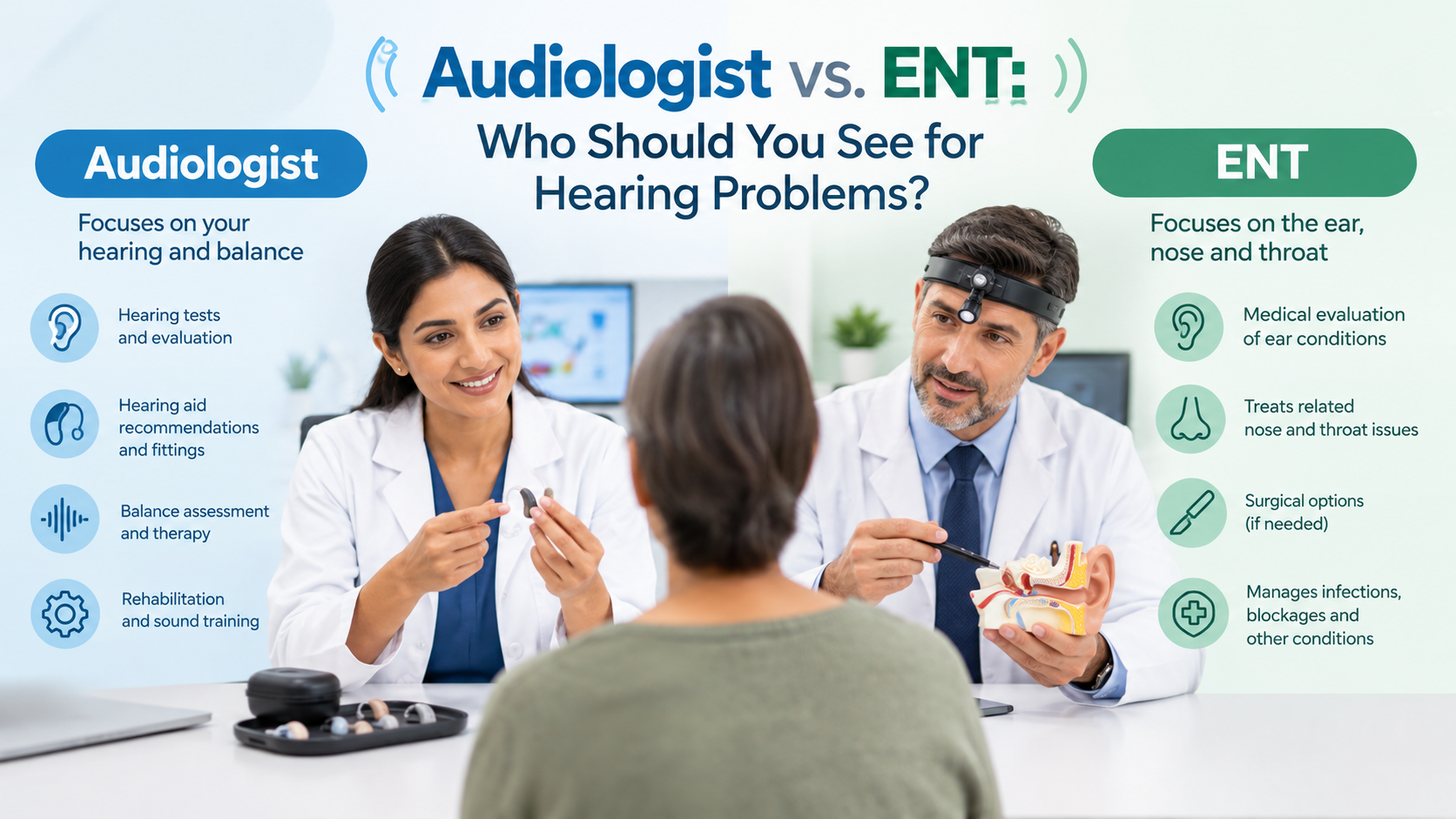
- An audiologist is a hearing and balance specialist who tests, diagnoses, and manages hearing loss, tinnitus, and balance issues, and who fits hearing aids and other devices.
- An ENT (ear, nose, and throat doctor, formally called an otolaryngologist) is a medical doctor and surgeon who diagnoses and treats medical and surgical conditions of the ear, nose, throat, and neck.
A simple way to remember it: the audiologist measures and manages hearing; the ENT treats medical causes and performs surgery. In practice, the best care often involves both.
| Feature | Audiologist | ENT (Otolaryngologist) |
|---|---|---|
| Type of professional | Hearing and balance healthcare specialist | Medical doctor and surgeon |
| Typical degree | Doctor of Audiology (AuD) or equivalent audiology degree | MD or DO, plus surgical residency |
| Prescribes medication | No (in most regions) | Yes |
| Performs surgery | No | Yes |
| Main strength | Hearing tests, hearing aids, tinnitus, and balance management | Medical diagnosis, medication, and surgery |
| Fits hearing aids | Yes | Rarely (usually refers to an audiologist) |
| Treats sinus, throat, and nose problems | No | Yes |
| Best first stop for | Gradual hearing loss, hearing aid needs, hearing tests | Pain, drainage, sudden changes, structural problems, infections |
The rest of this article explains what these differences mean for you.
What Is an Audiologist?
An audiologist is a licensed healthcare professional who specializes in the science of hearing and balance. In the United States, the entry-level degree is a Doctor of Audiology (AuD), a four-year graduate program that follows a bachelor’s degree and includes extensive clinical training. Requirements differ by country. In India, for example, audiologists typically train through programs in audiology and speech-language pathology and register with the national rehabilitation council, while in the United Kingdom, audiologists are regulated healthcare scientists. Always check the credentials that apply where you live.
What audiologists do
Audiologists focus on the function of your hearing and balance systems. Their typical services include:
- Comprehensive hearing evaluations: pure-tone testing (the familiar beeps in a sound booth), speech recognition testing, and tests of how well you understand words in background noise.
- Middle ear testing: tympanometry and acoustic reflex tests that check how well your eardrum and middle ear are working.
- Otoacoustic emissions (OAE) and auditory brainstem response (ABR) testing: objective tests used for infants, young children, and people who cannot respond to standard tests.
- Hearing aid selection, fitting, and programming: including verification measurements so the device is tuned to your specific hearing loss rather than simply switched on.
- Hearing aid follow-up and repair: adjustments, cleaning, troubleshooting, and long-term care.
- Tinnitus management: counseling, sound therapy, and retraining strategies.
- Balance and dizziness testing: assessments of the inner ear’s balance system, and in many clinics, repositioning maneuvers for conditions such as benign paroxysmal positional vertigo (BPPV).
- Cochlear implant support: candidacy testing, device mapping, and rehabilitation alongside a surgeon.
- Hearing protection and hearing conservation: custom earplugs, workplace noise programs, and musician’s earplugs.
- Pediatric audiology: newborn hearing screening follow-up, monitoring of children with fluid or language delays, and early intervention.
What audiologists cannot do
Audiologists are not physicians. They do not perform surgery, and in most places they cannot prescribe medication. If your test results suggest a medical or surgical issue, a good audiologist will refer you to an ENT or another physician.
What Is an ENT (Otolaryngologist)?
An ENT, or otolaryngologist, is a physician who completed medical school followed by a multi-year surgical residency, typically five years in the United States, in diseases and disorders of the ear, nose, throat, and related structures of the head and neck. Many pursue further fellowship training in a subspecialty.
Subspecialties you might encounter
- Otology and neurotology: disorders of the ear and the nerves connected to it, including ear surgery and cochlear implants.
- Rhinology: nose and sinus conditions.
- Laryngology: voice and throat disorders.
- Pediatric otolaryngology: ear, nose, and throat conditions in children, such as recurrent ear infections or enlarged adenoids.
- Head and neck surgery: tumors and structural problems.
- Facial plastic and reconstructive surgery.
For ear problems, an otologist or neurotologist is the most specialized option, but a general ENT is usually the right starting point.
What ENTs do for your ears
Because ENTs are physicians, they look for the medical cause of a symptom and treat it. For ear-related concerns, this includes:
- Diagnosing and treating ear infections, including chronic and recurrent infections.
- Examining the ear canal and eardrum with a microscope or endoscope.
- Removing earwax impactions, foreign objects, or debris that cannot be cleared easily.
- Treating eardrum perforations, cholesteatoma (an abnormal skin growth in the middle ear), and other structural problems.
- Placing ear tubes (tympanostomy tubes) to drain fluid, especially in children.
- Performing surgery such as tympanoplasty, stapedectomy for otosclerosis, and cochlear implant surgery.
- Evaluating sudden hearing loss, asymmetric hearing loss, and pulsatile tinnitus to rule out serious causes.
- Ordering imaging, such as MRI or CT scans, and blood tests when needed.
- Managing conditions such as Meniere’s disease, vestibular disorders, and facial nerve problems related to the ear.
- Treating nose, sinus, and throat conditions that can influence ear symptoms, such as allergies, sinusitis, and eustachian tube dysfunction.
Audiologist vs. ENT: The Key Differences Explained
Now that you know who each professional is, let’s look at the differences that matter most to patients.
1. Training and credentials
An audiologist’s training is concentrated on hearing, balance, and rehabilitation. An ENT’s training is far broader, covering the entire head and neck, plus surgical technique. Neither is “better.” They simply answer different questions.
2. Diagnose and manage vs. diagnose and treat
An audiologist can tell you how much hearing you have lost, what type of loss it is, and how it affects your daily communication. An ENT can tell you why it happened, whether it is medically or surgically treatable, and whether it is a sign of something that needs urgent attention.
3. Tools and equipment
Audiologists work with sound booths, audiometers, real-ear measurement systems, and hearing aid programming software. ENTs use otoscopes, operating microscopes, nasal endoscopes, and surgical instruments, and they order imaging. Many ENT clinics employ audiologists on-site so that testing and medical evaluation can happen in one visit.
4. Medication and surgery
Only the ENT can prescribe ear drops, oral antibiotics, or steroids, and only the ENT can operate. If your hearing loss can be fixed by treating an infection or repairing a structure, the ENT is the one who does it.
5. Devices and long-term support
If your hearing loss is permanent and cannot be corrected medically, the audiologist takes center stage. Hearing aids need ongoing programming, cleaning, and adjustment as your hearing and lifestyle change. Audiologists provide that continuing support.
6. Appointment style
Audiology appointments are often longer and more conversational, with extensive testing and counseling. ENT appointments tend to focus on examination, diagnosis, and a treatment plan, with the physician looking directly into your ear, nose, and throat.
When Should You See an Audiologist First?
For many people, the audiologist is a perfectly good first stop. Consider booking an audiologist if:
- You suspect gradual hearing loss. You have trouble following conversations in restaurants, you turn up the television, or family members say you mishear things. Slowly progressing, age-related and noise-related hearing loss is the most common situation, and an audiologist can quantify it.
- You want a baseline hearing test. Adults over 50, people with noisy jobs, and musicians benefit from a baseline so changes can be detected later.
- You need hearing aids or want to upgrade yours. Audiologists select, fit, and tune devices.
- You have mild, steady tinnitus without red-flag symptoms. An audiologist can assess your hearing, and offer sound therapy and counseling.
- You need hearing protection. Custom earplugs for work, concerts, shooting, or swimming.
- Your child failed a hearing screening. A pediatric audiologist can run detailed tests and guide next steps.
- You want a second set of ears on hearing aid problems. Feedback, discomfort, or poor sound quality can often be fixed with reprogramming.
If the audiologist finds anything suspicious, such as asymmetric results, signs of middle ear disease, or a sudden change, they will refer you to an ENT.
When Should You See an ENT First?
Some symptoms need a physician’s evaluation before anything else. See an ENT promptly, or go to urgent care or the emergency department as appropriate, if you have any of the following.
Red-flag symptoms
- Sudden hearing loss in one or both ears, especially if it developed over hours or a few days. Sudden sensorineural hearing loss is treated as a medical urgency, and treatment, often with steroids, is most effective when started early. Do not wait for a routine appointment.
- Hearing loss in only one ear, or a marked difference between the two ears.
- Ear pain, fever, or drainage of fluid, pus, or blood from the ear.
- Dizziness or vertigo with hearing changes, especially when severe or accompanied by vomiting.
- Pulsatile tinnitus, a rhythmic whooshing that matches your heartbeat.
- Tinnitus in only one ear.
- Facial weakness or numbness together with ear symptoms.
- A feeling of fullness or blockage that does not clear after a cold or flight.
- Hearing loss after head injury or a loud blast.
- A visible problem, such as a lump behind the ear, a foreign object in the ear canal, or a suspected perforated eardrum.
- Recurrent ear infections, especially in children.
If you have sudden hearing loss, facial drooping, severe vertigo, or neurological symptoms, treat it as an emergency and seek care immediately rather than waiting for an appointment.
Other reasons to start with an ENT
- You also have sinus, throat, voice, or swallowing problems.
- You are considering surgery or a cochlear implant.
- You have been told you have fluid behind the eardrum.
- You have earwax you cannot clear at home or a history of ear surgery.
Common Conditions: Who Handles What?
| Condition or concern | Audiologist role | ENT role |
|---|---|---|
| Age-related hearing loss | Test, diagnose, fit hearing aids | Rule out medical causes, if needed |
| Noise-induced hearing loss | Test, counsel, protection, hearing aids | Evaluate if sudden or asymmetric |
| Sudden hearing loss | Rapid testing, referral | Urgent diagnosis and treatment |
| Ear infections | Middle ear testing | Diagnosis, medication, tubes |
| Earwax blockage | Some clinics remove it | Removal and treatment of complications |
| Tinnitus | Hearing evaluation, sound therapy, counseling | Rule out underlying medical causes |
| Vertigo and dizziness | Balance testing, repositioning maneuvers | Diagnosis of inner ear and neurological causes, medication |
| Meniere’s disease | Hearing monitoring, hearing aids | Diagnosis, medication, procedures |
| Otosclerosis | Hearing tests, hearing aids | Surgery or medical management |
| Cholesteatoma | Hearing tests, referral | Surgery |
| Cochlear implants | Candidacy testing, programming, rehabilitation | Surgery |
| Childhood hearing concerns | Pediatric testing, devices | Tubes, adenoid evaluation, surgery |
Notice how often both professionals appear in the same row. That overlap is by design.
Hearing Aids: Should You Go to an Audiologist or an ENT?
This is one of the most searched variations of the audiologist vs. ENT question, so it deserves its own section.
For hearing aids, an audiologist is usually the right professional. They perform the detailed testing, recommend technology that fits your hearing loss and lifestyle, program the devices using verification measurements, and provide follow-up. Hearing aids that are poorly fitted are one of the biggest reasons people give up on them, so the quality of the fitting matters.
That said, the sequence can vary:
- If you have typical gradual hearing loss with no red flags, you can often go directly to an audiologist.
- If your test shows a medical red flag, the audiologist will send you to an ENT first. Hearing aids come after medical clearance.
- In some regions, regulations may require a medical evaluation, or a waiver, before hearing aids are fitted. Rules differ by country.
It is also worth knowing that over-the-counter (OTC) hearing aids became available in the United States in 2022 for adults with perceived mild to moderate hearing loss. They can be a reasonable option for some people, but they are not suitable for everyone. If you have sudden loss, one-sided loss, ear pain, or drainage, skip the OTC route and get evaluated. Even if you do buy an OTC device, an audiologist can test your hearing first and help you tell whether it is the right choice.
How Audiologists and ENTs Work Together
The audiologist vs. ENT debate sometimes makes it sound like you must pick a side. In reality, they are teammates. A typical care pathway looks like this:
- Hearing test with an audiologist. You get a detailed picture of your hearing.
- Medical review if indicated. If the results show asymmetry, a conductive component, or other warning signs, you are referred to an ENT.
- Medical or surgical treatment. The ENT treats infection, removes blockages, repairs structures, or orders imaging.
- Rehabilitation. If hearing loss remains, the audiologist helps with hearing aids, implants, tinnitus management, or communication strategies.
- Ongoing monitoring. Both may follow you over time, particularly if you have a progressive condition.
Many practices combine both specialties under one roof, so you can have your hearing tested and see the physician on the same day. If that option exists near you, it can save time and avoid repeated explanations of your symptoms.
Cost, Insurance, and Referrals
Cost is a real consideration, and it varies widely by country and by health plan.
- Audiologist visits often cost less than specialist physician visits for a basic hearing test. Hearing aids are typically the largest expense, and in many places insurance covers them only partially or not at all.
- ENT visits are generally billed as specialist medical visits. If surgery or imaging is needed, costs rise, but insurance is more likely to cover medically necessary treatment.
- Referrals: Some insurance plans require a referral from a primary care doctor before you can see an ENT. Many plans allow direct access to an audiologist, but not all. Check your plan before booking.
- Public and government programs: In some countries, hearing assessments and certain devices are available through public health systems or subsidy programs, and eligibility depends on age, income, or degree of loss.
A practical tip: call the clinic before you book. Ask whether the visit is covered, what the fee is, and whether you need a referral. If you suspect a medical problem, seeing the ENT first can sometimes make insurance coverage smoother, because the medical diagnosis supports later claims.
How to Choose a Good Audiologist or ENT
Whoever you pick, quality matters. Here is what to look for.
Choosing an audiologist
- Credentials: Confirm they are licensed or registered with the proper authority in your region.
- Comprehensive testing: A good evaluation goes beyond beeps and includes speech testing and middle ear checks.
- Brand flexibility: Ask whether they fit multiple hearing aid brands or only one or two.
- Verification: Ask whether they use real-ear measurements to confirm that the hearing aids are set correctly.
- Follow-up policy: Look for a trial period, included adjustments, and clear warranty terms.
- Communication: They should explain results in plain language and listen to your goals.
Choosing an ENT
- Board certification: Check that they are certified in otolaryngology.
- Ear experience: If your issue is ear-specific, ask whether they have an otology or neurotology focus.
- On-site audiology: Clinics with an audiologist on staff offer convenience and coordinated care.
- Clear plan: You should leave knowing the diagnosis, the options, and the next steps.
Questions worth asking at your first visit
- What do my test results mean in simple terms?
- Is my hearing loss temporary or permanent?
- Do I need a medical evaluation or imaging?
- What are all my treatment or device options, including the least expensive?
- What happens if I do nothing?
How to Prepare for Your Appointment
A little preparation makes either visit more productive.
- Write down your symptoms: When did they start? Is it one ear or both? Are there triggers?
- List medications and supplements: Some drugs can affect hearing, so this matters.
- Note your history: Ear infections, surgeries, head injuries, noise exposure, family history of hearing loss.
- Bring previous results: Earlier hearing tests help show whether things are changing.
- Bring a companion: A family member can describe what they notice and help you remember advice.
- Avoid cleaning your ears aggressively beforehand: Cotton swabs can push wax deeper or irritate the canal.
Why Acting Early Matters
Hearing loss is more than an inconvenience. Research has linked untreated hearing loss to social isolation, fatigue, and difficulty at work, and studies have associated it with a higher risk of cognitive decline in older adults. Globally, the World Health Organization estimates that more than a billion people are at risk of hearing loss from unsafe listening practices, and that the number of people living with hearing loss is expected to rise sharply over the coming decades.
The encouraging news is that most hearing loss can be managed, and some can be treated or even reversed when caught early. The sooner you get evaluated by the right professional, the more options you have.
Common Myths About Audiologists and ENTs
Myth 1: “An audiologist is just a hearing aid salesperson.” Audiologists are trained healthcare professionals who diagnose hearing and balance disorders. Selling devices is only one part of the job.
Myth 2: “An ENT can’t help with hearing loss, only infections.” ENTs diagnose the medical causes of hearing loss and perform surgeries that can restore or improve hearing.
Myth 3: “I only need to go once.” Hearing changes over time, and hearing aids need regular adjustments. Ongoing visits are normal.
Myth 4: “If I can hear sounds, my hearing is fine.” Many people hear sounds but struggle to understand speech, especially in noise. A full evaluation reveals this.
Myth 5: “Ringing in the ears is normal and harmless.” Occasional brief ringing is common, but persistent, one-sided, or pulsing tinnitus deserves evaluation.
Frequently Asked Questions
Is an audiologist or an ENT better for hearing loss?
Neither is universally better. An audiologist is best for measuring hearing loss and managing it with hearing aids. An ENT is best for finding and treating medical or surgical causes. Many people benefit from seeing both.
Do I need a referral to see an audiologist?
Often you do not, but it depends on your country and insurance plan. Check with the clinic and your insurer before booking.
Can an audiologist diagnose hearing loss?
Yes. Audiologists diagnose the type, degree, and pattern of hearing loss. They do not diagnose the underlying medical disease in the way a physician does, so they refer you to an ENT when a medical cause is suspected.
Can an ENT fit hearing aids?
Some ENT practices dispense hearing aids, usually through an on-site audiologist. Most ENTs refer patients to an audiologist for fitting.
Who should I see for tinnitus?
Start with an audiologist for a hearing test and tinnitus management if the ringing is mild, steady, and in both ears. See an ENT promptly if it is in one ear, pulsing, sudden, or comes with hearing loss, dizziness, or pain.
Who should I see for dizziness?
Both can help. An ENT evaluates the medical causes and an audiologist performs balance testing. Seek emergency care if dizziness comes with weakness, speech difficulty, severe headache, or vision changes, because those can signal a stroke.
Who should I see for earwax?
An ENT is the safest choice for stubborn or painful wax, especially if you have had ear surgery or a perforated eardrum. Some audiology clinics also offer wax removal for simple cases.
How often should adults get a hearing test?
Many guidelines suggest a baseline test in adulthood and periodic testing from about age 50 or sooner if you have noise exposure or symptoms. Ask your clinician what schedule suits you.
Is a hearing test done by an audiologist painful?
No. Standard hearing tests are painless and non-invasive. You listen to tones and words through headphones and respond.
Are over-the-counter hearing aids a replacement for seeing a specialist?
Not entirely. They may suit adults with mild to moderate loss who have no red-flag symptoms, but an evaluation helps you confirm that and avoid missing a medical issue.
A Simple Decision Guide
Still unsure? Use this quick checklist.
- Sudden change, pain, drainage, one-sided symptoms, or dizziness? See an ENT promptly, or seek urgent care for sudden hearing loss.
- Slow, steady change in both ears with no pain? Start with an audiologist.
- Need hearing aids or tinnitus therapy? Audiologist.
- Suspect an infection, blockage, or structural problem? ENT.
- Not sure at all? Start with your primary care doctor or a clinic that offers both, and let them guide you.
If you choose wrong, do not worry. Each professional is trained to refer you to the other when needed.
Conclusion: The Right Answer Is Often “Both”
The audiologist vs. ENT question does not have to be stressful. Think of the audiologist as the expert on how well you hear and how to help you hear better, and the ENT as the expert on why your ears are having trouble and how to fix what can be fixed. For sudden, painful, or one-sided symptoms, begin with the ENT. For gradual hearing changes, hearing aids, or tinnitus management, begin with the audiologist. And for the many situations in between, expect the two to work together.
The most important step is not which door you walk through first, but that you walk through one. Hearing health affects your relationships, your safety, your work, and your wellbeing, and early attention almost always leads to better outcomes.